The 2026 Savings Crisis: Why Traditional Budgeting is Failing and How to Automate Your Wealth
For the last decade, the personal finance industry has handed out the exact same piece of advice to anyone struggling to build wealth: follow the 50/30/20 rule. Spend 50% of your income on needs, 30% on wants, and save the remaining 20%. It is clean, it is mathematically elegant, and it looks fantastic on a spreadsheet.
It is also completely disconnected from the economic reality of 2026.
As we move deeper into the year, the financial foundation of the average household is showing severe cracks. The U.S. personal savings rate has plummeted to roughly 3.9% to 4.1%, hovering near historic lows and falling drastically short of the 7.5% pre-pandemic average [[2]], [[4]]. Families are not failing to save because they lack discipline or are buying too much artisanal coffee. They are failing to save because the cost of non-negotiable “needs”—housing, insurance, groceries, and childcare—has permanently reset at a much higher baseline, often consuming 60% to 70% of a paycheck before a single “want” is even considered.
If you are trying to force your modern financial life into a 2015 budgeting framework, you will only end up frustrated and broke. The most financially resilient people in 2026 have abandoned rigid percentage rules in favor of hyper-intentional allocation and frictionless automation. Here is the data-backed blueprint for saving and budgeting in an era where every single dollar must fight for its survival.
The Death of the 50/30/20 Rule (And the Rise of Zero-Based Budgeting)
The fundamental flaw of the 50/30/20 rule is that it assumes your “needs” will neatly cap at half your income. When rent or a mortgage eats up 45% of your take-home pay by itself, the rule immediately breaks down, leading to guilt and budget abandonment.
The modern alternative that financial professionals are aggressively adopting is Zero-Based Budgeting (ZBB). Unlike percentage-based models, zero-based budgeting operates on a single, uncompromising formula: Income minus Expenses (including savings) equals Zero. [[14]].
This does not mean you have zero dollars left in your bank account; it means every single dollar is assigned a specific “job” before the month even begins. Your money is deliberately directed toward rent, groceries, debt payoff, and investment accounts until there is no “unassigned” cash left floating in your checking account to be accidentally spent on impulse purchases.
The Fix: Many financial planners now recommend a hybrid approach. You can use the 50/30/20 rule to set broad, aspirational categories, but you must apply zero-based budgeting for tight, month-to-month control [[17]]. By giving every dollar a job, you shift your mindset from “What did I spend my money on?” to “What is my money doing for me?”
The $2.9 Billion Automation Boom: Removing Human Friction
The greatest threat to your savings rate is not a lack of income; it is human psychology. We are biologically wired to prioritize immediate gratification over long-term security. If you have to manually log into your bank account every month and click “transfer” to move money into your savings, you are relying on willpower. And willpower is a finite resource that inevitably runs out.
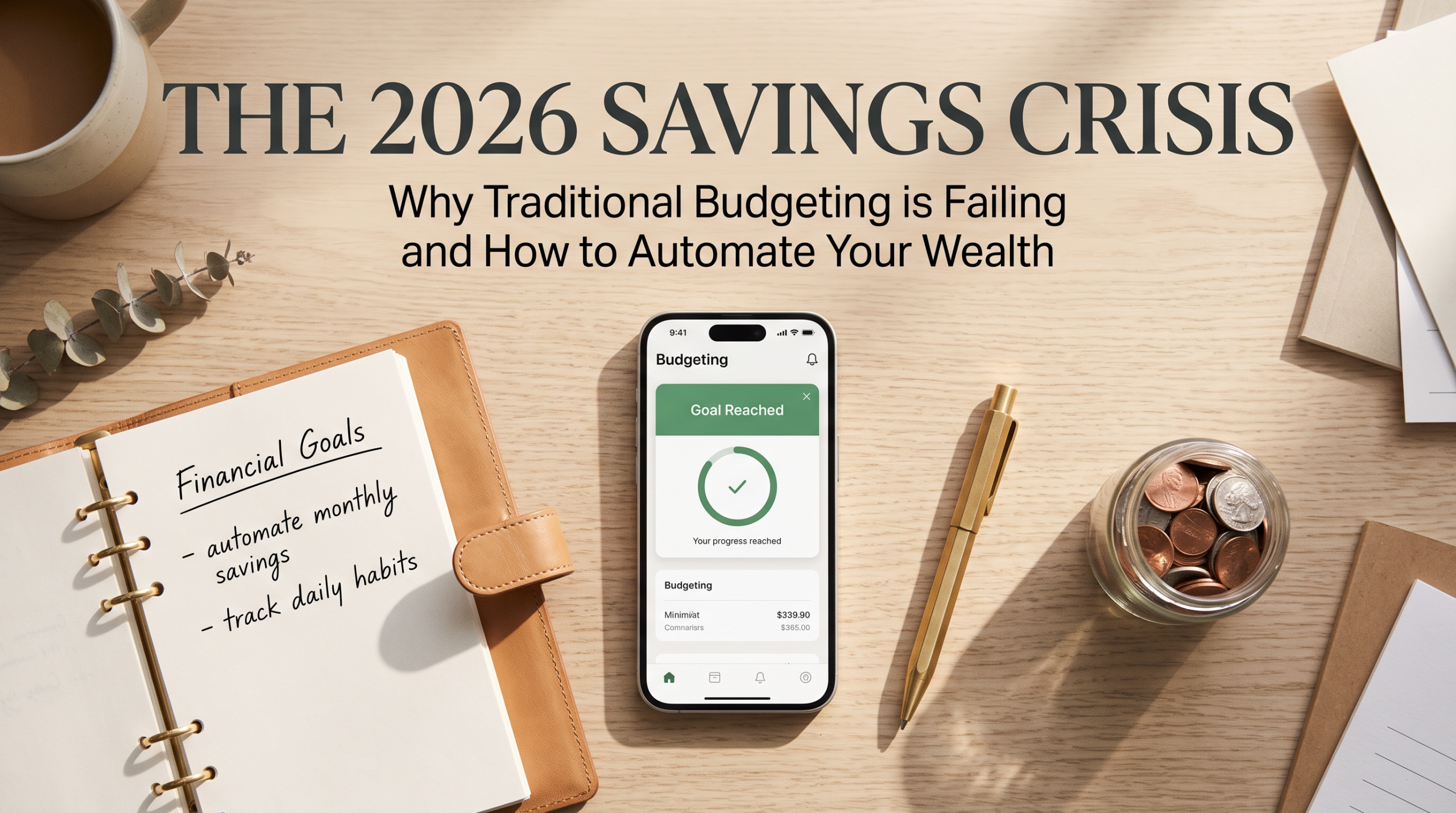
This psychological reality has triggered a massive boom in automated savings and micro-investing platforms. The micro-investing app market is projected to hit $2.9 billion in revenue in 2026, driven entirely by the rising adoption of automated savings rules and round-up applications [[21]]. Furthermore, a staggering 76% of users agree that digital apps drastically simplify the process of saving and investing, effectively removing the behavioral barriers to building wealth [[27]].
Employers are also catching on. A recent survey found that 34% of large U.S. employers are actively considering adding automated savings apps directly into their employee financial wellness suites, allowing workers to split their direct deposit seamlessly before the money even hits their primary checking account [[22]].
The Fix: Build an invisible savings infrastructure.
- Payroll Splitting: Ask your HR department if you can split your direct deposit. Route 10% to 20% directly into a High-Yield Savings Account (HYSA) or investment account, and let the remainder hit your checking account for daily living expenses. You cannot spend what you never see.
- Round-Up Applications: Utilize apps that round up your daily debit card purchases to the nearest dollar and automatically invest or save the spare change. It feels painless on a micro-level but compounds into hundreds of dollars a year.
The “Reverse Budget” and the HYSA Mandate
If zero-based budgeting feels too tedious and tracking every expense makes you want to quit entirely, there is a highly effective, low-friction alternative known as the “Reverse Budget.”
Instead of tracking where your money goes, you simply automate where your money must go first. You calculate your fixed financial goals—your emergency fund contribution, your Roth IRA max-out, and your debt payoff—and you automate those transfers to occur the exact morning your paycheck clears. Whatever is left in your checking account is yours to spend entirely guilt-free on wants, dining out, and entertainment.
However, the success of this strategy relies entirely on where you park your automated savings. In 2026, leaving your emergency fund in a traditional brick-and-mortar bank savings account earning 0.01% interest is financial negligence. Top-tier online banks and fintech platforms are currently offering High-Yield Savings Accounts (HYSAs) paying between 4% and 5% APY. Moving your automated savings to an HYSA ensures your cash is actively fighting inflation while remaining entirely liquid for emergencies.
3 Actionable Steps to Bulletproof Your Finances This Month
You do not need a massive salary increase to improve your financial trajectory. You just need to optimize the cash flow you already have. Execute these three steps this weekend.
1. Conduct a “Subscription and Leakage” Audit
Before you can save more, you must stop the bleeding. The average household loses hundreds of dollars a month to “zombie subscriptions”—streaming services, app memberships, and premium delivery passes they signed up for and forgot about.
Action: Print out your last 60 days of bank and credit card statements. Take a physical highlighter and mark every single recurring charge. Ruthlessly cancel anything you have not actively used in the last 30 days. Route the exact dollar amount of those canceled subscriptions into an automated transfer to your HYSA.
2. Implement the “24-Hour Rule” for Discretionary Spending
E-commerce and social media algorithms are specifically engineered to trigger impulse purchases by creating a false sense of urgency.
Action: Institute a mandatory 24-hour waiting period for any non-essential purchase over $50. Leave the item in your digital cart and close the tab. In the vast majority of cases, the dopamine-driven urge to buy will fade by the next morning, saving you from buyer’s remorse and preserving your capital for your actual financial goals.
3. Gamify Your “No-Spend” Days
Budgeting often feels restrictive, which leads to binge-spending. Gamification flips the psychological script, turning frugality into a challenge rather than a punishment.
Action: Designate two days a week as “No-Spend Days” where you commit to spending absolutely zero dollars outside of pre-paid fixed bills. Meal prep, make coffee at home, and utilize free entertainment. Track your success on a physical calendar. Seeing a visual streak of successful no-spend days triggers the brain’s reward centers, making the habit stick.
Sources & References
- [2] Trading Economics. (2026). United States Personal Savings Rate: Household Saving Rate in the United States decreased to 4.10 percent in August 2026. Retrieved from tradingeconomics.com
- [4] Steven Rattner / Economic Data. (2026). The U.S. personal savings rate in March 2026: 3.9% — near historic lows, compared to a pre-pandemic average of 7.5%. Retrieved from facebook.com/StevenLRattner
- [14] Ramsey Solutions. (2026). Zero-Based Budgeting: What It Is and How to Use It: Income minus allocated spending equals zero, giving every dollar a specific assignment. Retrieved from ramseysolutions.com
- [17] Anderson AE. (2025/2026). What is Zero-Based Budgeting? The two systems can complement each other; use 50/30/20 for broad categories and ZBB for tight control. Retrieved from anderson.ae
- [21] Globe Market Research. (2026). Micro Investing App Market: Market Revenue in 2026 projected at USD 2.9 Billion, driven by automated savings tools. Retrieved from globemarketresearch.com
- [22] Dataintelo / Mercer Survey. (2025/2026). Round-Up Savings App Market: 34% of large U.S. employers were considering adding an automated savings app to their financial wellness suite. Retrieved from dataintelo.com
- [27] RJPN / Digital Investment Impact. (2026). The Impact of Digital Investment Apps: A large majority (76%) agree that digital apps simplify investing and automated savings. Retrieved from rjpn.org
The Bottom Line
Saving money in 2026 is not about depriving yourself of joy or adhering to an outdated, rigid percentage formula. It is about acknowledging the reality of your expenses, assigning every dollar a deliberate purpose, and building an automated infrastructure that protects your future self from your present impulses. Stop relying on willpower. Build a system, let the algorithms do the heavy lifting, and watch your financial resilience compound.