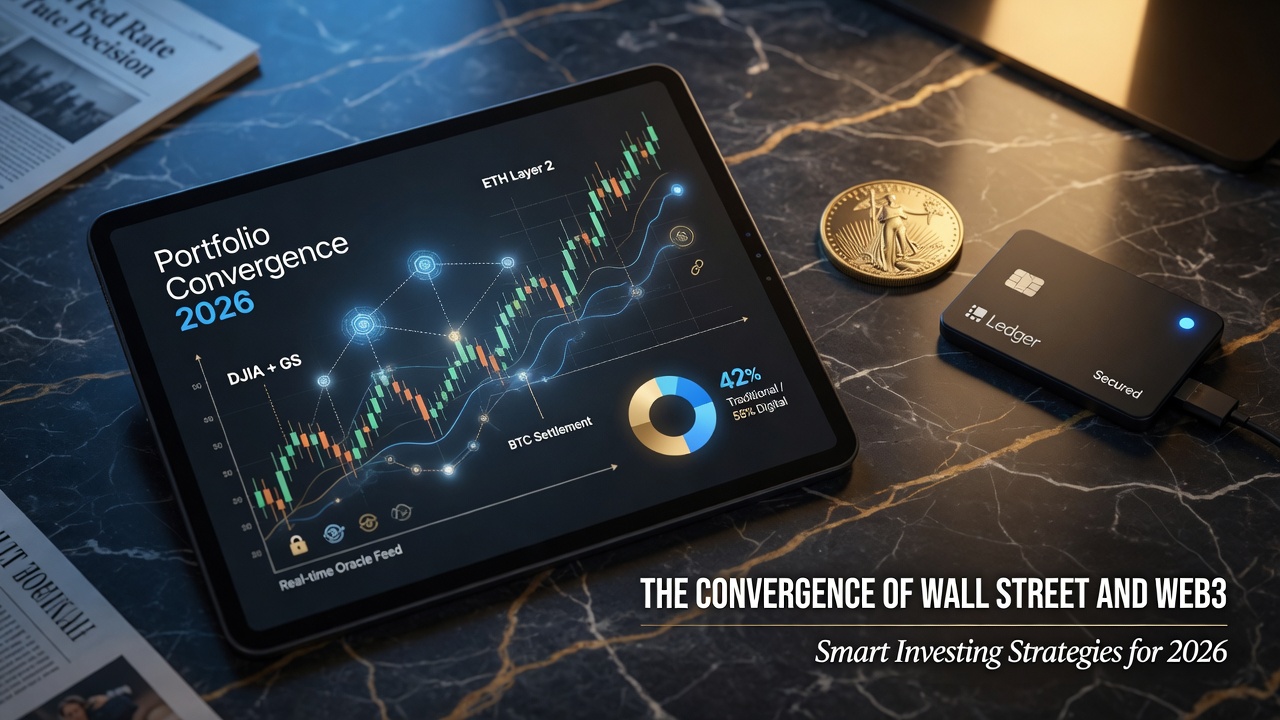
The Convergence of Wall Street and Web3: Smart Investing Strategies for 2026
For years, the financial world operated in two distinct, often hostile, camps. On one side stood Traditional Finance (TradFi): a realm of regulated ETFs, index funds, and steady, compound growth managed by legacy institutions. On the other side was the Wild West of cryptocurrency: a landscape defined by extreme volatility, speculative meme coins, and regulatory ambiguity.
In 2026, that binary division is obsolete.
The walls between Wall Street and Web3 have not just cracked; they have been systematically dismantled. The approval and subsequent massive adoption of spot Bitcoin Exchange-Traded Funds (ETFs) have fundamentally legitimized digital assets as a standard component of institutional portfolio management. Simultaneously, the explosive growth of Real-World Asset (RWA) tokenization is bringing the efficiency of blockchain technology to traditional markets like real estate, treasury bills, and private equity.
For the modern investor, this convergence presents unprecedented opportunities, but it also demands a higher level of financial literacy. The days of blindly throwing money at any asset with a ticker symbol are over. Here is the data-backed reality of the investing and crypto landscape in 2026, and how you can strategically position your portfolio for the future.
The Bitcoin ETF Era: From Speculation to Institutional Standard
The narrative that Bitcoin is solely a speculative toy for retail gamblers was definitively shattered by the launch of U.S. spot Bitcoin ETFs. What began as a regulatory battle culminated in a watershed moment for digital asset adoption. The approval of these ETFs triggered over $30 billion in first-year inflows, effectively validating cryptocurrency as a legitimate, fiduciary-approved asset class [[13]].
The scale of this institutional embrace is staggering. By early 2026, the total Assets Under Management (AUM) for spot Bitcoin ETFs peaked at approximately $128 billion to $135 billion [[14]]. This is not “dumb money” chasing hype; this is pension funds, family offices, and registered investment advisors (RIAs) allocating 1% to 3% of their portfolios to Bitcoin as a non-correlated hedge against inflation and fiat currency debasement.
The Investor Takeaway: If you are going to hold Bitcoin in 2026, the most tax-efficient, secure, and straightforward method for most investors is no longer navigating complex self-custody wallets or unregulated offshore exchanges. Utilizing a regulated, low-fee spot Bitcoin ETF within a standard brokerage or retirement account provides institutional-grade security, seamless tax reporting, and eliminates the risk of losing your private keys.
The Quiet Revolution: Real-World Asset (RWA) Tokenization
While Bitcoin ETFs dominate the headlines, the most profound structural shift in finance is happening quietly in the background: the tokenization of Real-World Assets (RWA). Tokenization is the process of representing ownership of a physical or traditional financial asset (like a share of real estate, a corporate bond, or a fine art painting) as a digital token on a blockchain.
Why does this matter? Because it solves the twin problems of illiquidity and high barriers to entry. Historically, investing in commercial real estate or private credit required millions of dollars and locked up your capital for years. Tokenization fractionalizes these assets, allowing retail investors to buy $100 worth of a tokenized treasury bill or a fractional share of a rental property, with the ability to trade it 24/7 on compliant digital exchanges.
The growth of this sector is exponential. The tokenized RWA market reached a size of approximately $24 billion in 2025, representing a massive increase from previous years, and continues to expand rapidly as major financial institutions like BlackRock and Franklin Templeton launch their own tokenized fund structures [[23]], [[29]].
The Investor Takeaway: Keep a close eye on regulated platforms offering tokenized U.S. Treasuries and money market funds. In a higher-for-longer interest rate environment, these tokenized assets offer a compelling way to earn yield on your idle cash with the added benefit of near-instant settlement, bypassing the traditional T+2 banking delays.
Retail Investing 2.0: The Death of the “Dumb Money” Myth
The term “retail investor” used to carry a pejorative connotation, implying an uninformed individual making emotional, reactionary trades. The data from 2026 tells a completely different story. Retail investors are now highly sophisticated, leveraging advanced wealthtech platforms to drive meaningful market engagement.
Modern retail investing is defined by three key trends:
- Fractional Ownership: Investors are no longer priced out of high-value stocks. Fractional shares allow for precise portfolio allocation and dollar-cost averaging, regardless of account size [[1]].
- ESG and Governance Focus: Retail capital is increasingly flowing toward companies with strong Environmental, Social, and Governance (ESG) metrics, actively using shareholder voting rights to influence corporate behavior [[1]].
- AI-Driven Predictive Analytics: Next-generation brokerage platforms are integrating predictive analytics that help retail investors anticipate market shifts and manage emotional trading biases, leveling the playing field against institutional algorithms [[5]].
The Investor Takeaway: Leverage the tools available to you, but do not outsource your critical thinking to an algorithm. Use fractional shares to build a diversified, globally balanced portfolio. Use screeners to find value, but always conduct your own fundamental due diligence before committing capital.
3 Non-Negotiable Rules for the 2026 Investor
The convergence of TradFi and crypto creates a richer investment universe, but it also introduces new vectors of risk. Protect your capital by adhering to these three principles.
1. Define Your Crypto Allocation Strategically
Treat digital assets as a distinct, high-volatility asset class, not as a substitute for your core equity or bond holdings. Financial advisors generally recommend capping speculative or high-growth digital asset exposure to between 1% and 5% of your total net worth. This ensures that if the asset goes to zero, your financial future is not derailed, but if it experiences a multi-bagger return, it meaningfully impacts your portfolio.
2. Understand the Tax Implications of Digital Assets
The IRS and global tax authorities have significantly cracked down on crypto tax evasion. Every trade, swap, or use of cryptocurrency to purchase goods is a taxable event. Furthermore, the regulatory clarity surrounding RWA tokenization means these assets are increasingly subject to traditional capital gains and dividend tax rules.
Action: Use dedicated crypto tax software (like Koinly or CoinTracker) that integrates directly with your wallets and exchanges to generate accurate, audit-proof tax reports. Do not wait until April to figure out your cost basis.
3. Prioritize Regulated Infrastructure Over Yield Chasing
The collapse of several high-profile, unregulated crypto lending platforms in the early 2020s served as a brutal, expensive lesson: if an investment offers a guaranteed 15% APY in a low-risk environment, it is a Ponzi scheme.
Action: If you want yield, stick to regulated, transparent instruments. Tokenized U.S. Treasuries, staking through major, publicly audited exchanges, or traditional high-yield savings accounts are the only sustainable ways to generate passive income. Never invest in a “black box” protocol you do not fully understand.
Sources & References
- [1] Proxymity / Robinhood Policy. (2025/2026). Retail Investing Trends: How retail investors are redefining market engagement through fractional shares, ESG focus, and governance reform. Retrieved from proxymity.io / robinhood.com
- [5] Billcut / Wealthtech Analysis. (2026). Wealthtech Platforms Redefining Retail Investing: The development of predictive analytics to anticipate investor behavior and market shifts. Retrieved from billcut.com
- [13] XBTO Group. (2026). Institutional Crypto Adoption 2026: Bitcoin ETF approval triggered $30+ billion in first-year inflows, validating crypto as a legitimate asset class for fiduciaries. Retrieved from xbto.com
- [14] ICFS / Digital Asset Market Overview. (2026). Spot Bitcoin ETF AUM peaked at approximately $128-135 billion in early 2026, representing remarkable institutional growth. Retrieved from icfs.com
- [23] Katten Law / Market Analysis. (2025/2026). Tokenization of Real-World Assets: The RWA tokenization market reached $24 billion in size, bridging traditional finance and blockchain. Retrieved from katten.com
- [29] Market.us Research. (2025/2026). Tokenized Assets Market Trend: The tokenization of real-world assets expanded rapidly, reaching a market size of $24 billion in 2025. Retrieved from market.us
The Bottom Line
The investing landscape of 2026 is not about choosing between the stock market and cryptocurrency. It is about understanding how these two worlds are merging to create a more efficient, accessible, and diversified financial ecosystem. By embracing regulated digital asset exposure, exploring the potential of RWA tokenization, and utilizing modern retail investing tools responsibly, you can build a resilient portfolio designed to thrive in the next decade of financial evolution.