
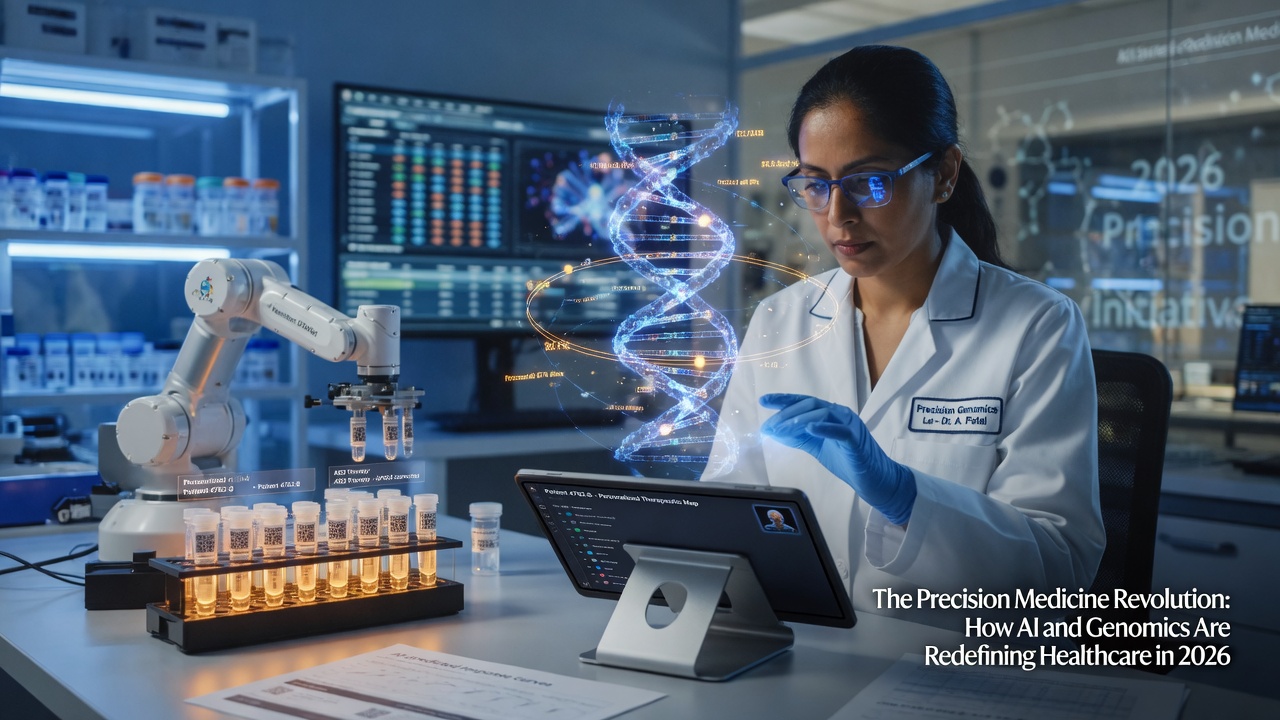
The Precision Medicine Revolution: How AI and Genomics Are Redefining Healthcare in 2026
For over a century, the foundational model of Western medicine has been reactive and generalized. You present with a set of symptoms, the doctor matches them to a standard diagnosis, and you are prescribed a one-size-fits-all treatment protocol. If the medication works, great. If it causes adverse side effects or fails entirely, the doctor simply tries the next drug on the list.
This “trial and error” approach is rapidly becoming obsolete.
As we navigate 2026, we are witnessing the maturation of the Precision Medicine Revolution. Driven by the convergence of artificial intelligence, advanced genomics, and continuous biosensor technology, healthcare is shifting from a reactive “sick care” model to a proactive, highly personalized “healthcare” model. Treatments are no longer designed for the “average” patient; they are being tailored to the unique genetic, environmental, and lifestyle profile of the individual.
This is not a distant futuristic promise. It is happening in clinics, laboratories, and living rooms right now. Here is the data-backed reality of the health and science breakthroughs that are redefining human longevity and disease management in 2026.
The AI Precision Medicine Boom
Artificial Intelligence is no longer just a tool for administrative tasks in hospitals; it is the engine driving the next generation of drug discovery and personalized treatment plans. AI algorithms can now analyze vast, complex datasets—including genomic sequences, electronic health records, and proteomic data—to identify disease biomarkers and predict patient responses to specific therapies with unprecedented accuracy.
The financial and clinical momentum behind this is staggering. The global AI in precision medicine market, valued at approximately $1.3 billion to $2.4 billion in 2025, is projected to surge to between $18 billion and $32.5 billion by the early 2030s, growing at a compound annual growth rate (CAGR) of over 25% to 38% [[1]]. This explosive growth is fueled by the undeniable clinical outcomes: AI-driven precision medicine is significantly reducing the time it takes to bring new targeted therapies to market and improving patient survival rates in complex conditions like oncology and rare genetic disorders [[6]].
For the average person, this means that in the near future, a cancer diagnosis will not just be met with a standard chemotherapy regimen. Instead, an AI will analyze the specific mutational profile of your tumor and recommend a targeted therapy designed to attack those exact cells while sparing healthy tissue.
CRISPR and Gene Therapy: From Science Fiction to Standard of Care
Perhaps the most profound scientific achievement of the last decade is the clinical validation of CRISPR-Cas9 gene editing. Once confined to academic laboratories and ethical debates, CRISPR is now actively curing previously untreatable genetic diseases.
The landmark moment came with the approval of Casgevy (exa-cel), the world’s first CRISPR-based gene therapy. Initially approved for adults, the U.S. Food and Drug Administration (FDA) recently expanded the label for Casgevy to include children as young as two years old suffering from severe sickle cell disease and transfusion-dependent beta-thalassemia [[18]]. This pioneering case marks the first successful, widespread use of personalized CRISPR gene therapy in human patients, demonstrating the technology’s ability to permanently rewrite faulty genetic code and provide a functional cure [[16]].
While challenges remain regarding the high cost of these therapies and the complexity of in vivo (inside the body) delivery, the trajectory is clear. The pipeline of global CRISPR therapeutics is expanding rapidly, with clinical trials actively underway for conditions ranging from certain types of inherited blindness to muscular dystrophy and specific cardiovascular diseases [[13]]. We are transitioning from merely managing the symptoms of genetic diseases to actively correcting their root cause.
The Wearable Health Monitor Evolution: Beyond Step Counting
The consumer wearable market has evolved far beyond counting steps and estimating sleep duration. In 2026, wearable health monitors are transitioning from “wellness gadgets” to FDA-regulated medical devices capable of continuous, clinical-grade physiological monitoring.
The prime example of this shift is the Continuous Glucose Monitor (CGM). Originally designed exclusively for diabetics, CGMs are now being adopted by a broader health-conscious demographic to understand how specific foods, stress, and sleep impact their metabolic health. In 2025, the U.S. Health Department actively committed to promoting wearable health monitors, emphasizing glucose monitoring devices as a cornerstone of preventative health initiatives [[22]].
Furthermore, strict regulatory pathways enforced by the FDA and CE Mark in Europe ensure that these devices meet rigorous standards for product safety, accuracy, and reliability [[21]]. We are also seeing the emergence of next-generation biosensors, including skin-embedded patches and non-invasive optical sensors, capable of monitoring a wider array of biomarkers, such as cortisol (stress), lactate (muscle fatigue), and even early indicators of fertility and hormonal shifts [[26]].
These devices are creating a continuous, real-time stream of personal health data, empowering individuals and their doctors to make micro-adjustments to lifestyle and medication before a minor issue becomes a major medical event.
The Data Privacy Challenge in Personalized Health
With great data comes great responsibility. The precision medicine revolution relies entirely on the collection and analysis of highly sensitive personal health information (PHI), including your entire genomic sequence. This creates a massive target for data breaches and raises profound ethical questions about who owns your biological data.
As wearable smart sensors integrate more deeply with AI and machine learning, concerns about data misuse and breaches are growing [[30]]. If a health insurance company gains access to your predictive genetic risk profile, could you be denied coverage or charged higher premiums?
The Fix: The scientific and regulatory communities are responding with “Privacy-Enhancing Technologies” (PETs). Techniques like federated learning allow AI models to be trained on decentralized hospital data without the raw patient data ever leaving the local server. Additionally, robust legislative frameworks, such as updates to the Genetic Information Nondiscrimination Act (GINA) and strict GDPR/HIPAA enforcement, are being actively tested to ensure that your genomic data cannot be weaponized against you [[14]]. As a consumer, you must remain vigilant: always read the privacy policies of health apps and opt out of third-party data sharing whenever possible.
Sources & References
- [1] DelveInsight / Grand View Research. (2025/2026). AI in Precision Medicine Market Summary: Market size to surge from USD 1.3B-$2.4B in 2025 to over USD 18B-$32.5B by 2033/2034. Retrieved from delveinsight.com / grandviewresearch.com
- [6] Frontiers in Public Health. (2025). AI-driven transformation of precision medicine: Elucidating the pivotal role of AI in comprehensively analyzing and improving patient outcomes. Retrieved from frontiersin.org
- [13] ScienceDirect / Molecular Therapy. (2026). The landscape and trajectory of global CRISPR therapeutics: Summarizing active clinical trials and FDA regulatory milestones. Retrieved from sciencedirect.com
- [16] Grand View Research. (2025/2026). Gene Therapy Platform Market Size Report: This pioneering case marks the first successful use of personalized CRISPR gene therapy in a human patient. Retrieved from grandviewresearch.com
- [18] BioPharm International. (2026). FDA Expands Casgevy Label to Children as Young as 2, Broadening Access to First CRISPR Gene Therapy for Sickle Cell Disease. Retrieved from biopharminternational.com
- [21] Grand View Research. (2025/2026). Continuous Glucose Monitoring Devices Market Report: Strict regulatory pathways (FDA, CE Mark) ensure product safety, accuracy, and reliability. Retrieved from grandviewresearch.com
- [22] Industry Research Biz. (2025/2026). Continuous Glucose Monitoring (CGM) Market Size & Share: U.S. Health Department committed to promoting wearable health monitors in preventative health initiatives. Retrieved from industryresearch.biz
- [26] American Society for Reproductive Medicine (ASRM). (2025). Wearable Health Monitors and Fertility: Devices tracking a wide range of biomarkers, physiological signals, and bodily functions. Retrieved from asrm.org
- [30] ScienceDirect. (2025/2026). Wearable smart sensors integration with AI: Addressing concerns about misuse and data breaches through enhanced security measures. Retrieved from sciencedirect.com
The Bottom Line
The health and science landscape of 2026 is defined by a fundamental shift in power: from the physician’s textbook to the patient’s unique biology. AI is accelerating drug discovery, CRISPR is curing the incurable, and wearable biosensors are giving us unprecedented insight into our daily metabolic health. While we must remain vigilant about data privacy, the trajectory is undeniably positive. We are no longer just treating disease; we are engineering a future of prolonged, vibrant, and highly personalized human health.


