The End of Hustle Culture: Building a Sustainable Health & Mindset Framework in 2026
For the better part of the last decade, the dominant cultural narrative around health and success was defined by “hustle culture.” The mantra was simple: sleep when you’re dead, optimize every waking minute, and push through the pain. Wellness was treated as another metric to hack, leading to a surge in extreme biohacking, restrictive diets, and the glorification of chronic stress.
The bill for that lifestyle has finally come due.
As we move through 2026, we are witnessing a massive, data-backed correction in how society approaches well-being. The focus has shifted from performative productivity to “whole-person” holistic health. Consumers and professionals alike are realizing that you cannot out-supplement a bad night’s sleep, and no amount of morning ice baths can fix a fundamentally broken relationship with work and stress.
The organizations and individuals thriving in 2026 are those who understand that health is not a series of isolated optimizations, but an interconnected ecosystem. Here is the evidence-based framework for building a sustainable health and mindset routine that actually protects your energy, sharpens your cognition, and lasts a lifetime.
The Shift to “Whole-Person” Holistic Health
The modern definition of wellness has expanded far beyond the gym and the salad bar. Today, holistic health is recognized as an integrated practice encompassing five core pillars: physical fitness, mindfulness, mental health support (therapy), nutrition, and social connection [[1]].
This is not just a philosophical shift; it is a market reality. Brands and healthcare providers that succeed in 2026 are those that address specific needs within this holistic spectrum, moving away from one-size-fits-all solutions toward personalized, preventative care [[5]]. The goal is no longer to achieve a fleeting state of peak performance at the cost of your long-term health, but to build a resilient baseline that allows you to show up consistently, day after day, without burning out.
The $1 Trillion Problem: Why Mental Health is a Productivity Imperative
For years, mental health was treated as a purely personal issue, separate from professional performance. The data now proves this is a catastrophic false dichotomy. Poor mental health, particularly untreated anxiety and depression, contributes to an estimated $1 trillion in lost global productivity annually due to absenteeism and “presenteeism” (being physically at work but mentally disengaged) [[19]].
Conversely, the return on investment for prioritizing mental well-being is staggering. Research consistently shows that for every $1 invested in scaled mental health support, organizations see a $4 return in reduced medical spending, better productivity, and lower turnover [[15]].
On an individual level, the signs of ignoring this are clear. Recent polling indicates that over half of workers feel burned out by their jobs, and nearly 40% feel so overwhelmed that it actively impairs their ability to function [[14]]. If you are experiencing this, the solution is not to push harder; it is to establish firm boundaries and integrate genuine mental recovery into your daily routine.
Sleep Hygiene: The Non-Negotiable Foundation of Cognitive Performance
If there is a single “magic pill” for health, mindset, and productivity, it is high-quality sleep. Yet, it remains the most sacrificed element of the modern lifestyle. The science is unequivocal: proper sleep hygiene practices significantly contribute to improved cognitive performance, emotional regulation, and psychological resilience [[23]].
Sleep is not a passive state of rest; it is an active neurological process. During deep sleep, the brain’s glymphatic system clears out metabolic waste products (including beta-amyloid, a protein linked to cognitive decline). During REM sleep, the brain processes emotional experiences and consolidates memory. When you cut your sleep short, you are not “gaining time”; you are actively impairing your brain’s ability to function the next day.
The Fix: Treat sleep with the same discipline you apply to your most important work meetings.
- The 3-2-1 Rule: Stop eating heavy meals 3 hours before bed. Stop all work-related screens and intense cognitive tasks 2 hours before bed. Stop all ambient light and phone usage 1 hour before bed.
- Temperature and Light Control: Your core body temperature needs to drop to initiate deep sleep. Keep your bedroom cool (around 65°F or 18°C) and pitch black. If you must use a device, enable aggressive blue-light filters, but ideally, leave the phone in another room.
- Consistency Over Duration: Going to bed and waking up at the exact same time every day (even on weekends) is more impactful for your circadian rhythm than occasionally sleeping in to “catch up.”
3 Actionable Steps to Build Your 2026 Mindset Framework
Knowing the science is only half the battle. The challenge is implementation. Here are three frictionless, high-impact habits to integrate into your life this week.
1. Implement “Cognitive Offloading”
Your brain is designed for having ideas, not for holding them. Trying to remember every task, appointment, and fleeting thought creates a low-level background anxiety known as the “Zeigarnik effect” (the tendency to remember uncompleted tasks).
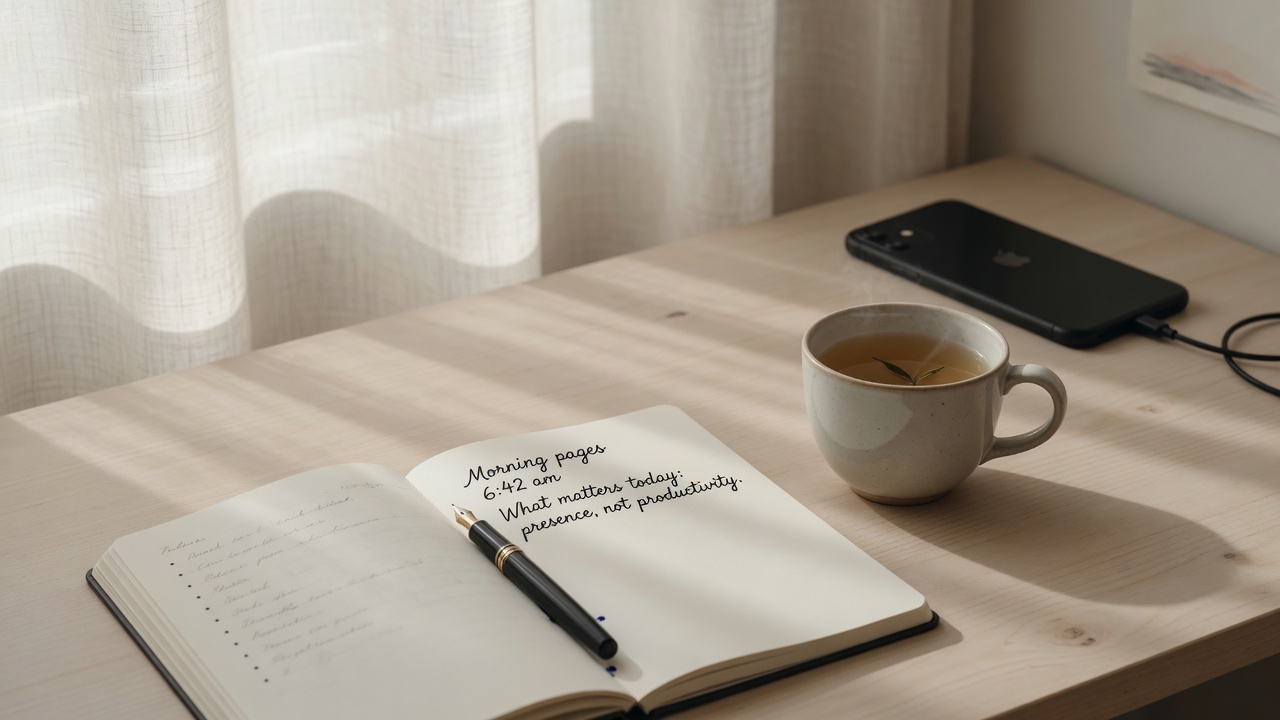
Action: Keep a physical notebook or a dedicated digital app (like Notion or Apple Notes) open at all times. The moment a task or worry pops into your head, write it down. This simple act of “cognitive offloading” signals to your brain that the information is safe, instantly reducing mental clutter and freeing up working memory for deep focus.
2. Redefine “Rest” as an Active Practice
Scrolling through social media or binge-watching television is not rest; it is high-dopamine stimulation that keeps your nervous system in a state of low-grade arousal. True rest requires a shift in your physiological state.
Action: Schedule 15 to 20 minutes of “non-sleep deep rest” (NSDR) or guided mindfulness into your afternoon. Studies show that even brief mindfulness practices can lower cortisol levels, reduce heart rate, and reset your focus for the second half of the day [[26]]. You do not need to meditate for an hour; five minutes of deliberate, diaphragmatic breathing is enough to shift your nervous system from “fight or flight” to “rest and digest.”
3. Audit Your Information Diet
Just as junk food degrades your physical health, a diet of doomscrolling, outrage news, and toxic online discourse degrades your mental health. Your mindset is directly shaped by the inputs you allow into your consciousness.
Action: Conduct a ruthless audit of your media consumption. Unfollow accounts that make you feel anxious, inadequate, or angry. Replace 30 minutes of daily news consumption with a long-form podcast, a physical book, or a walk outside without your phone. Protect your attention as fiercely as you protect your bank account.
Sources & References
- [1] Wellhub. (2025/2026). State of Work-Life Wellness: Workers increasingly expect employers to enable holistic health across the five pillars of wellness: fitness, mindfulness, therapy, nutrition, and sleep. Retrieved from wellhub.com
- [5] Circana. (2026). Health & Wellness Market Trends: Brands can succeed by developing products that address specific needs within the holistic health spectrum. Retrieved from circana.com
- [14] NAMI-Ipsos. (2026). Workplace Mental Health Poll: 53% felt burned out because of their job, and 39% felt so overwhelmed it was hard to do their job. Retrieved from nami.org
- [15] ActivTrak / WHO Data. (2025/2026). Workplace Productivity Statistics: For every $1 a company invests in employee mental health, it sees a return of $4 in reduced medical spending and better productivity. Retrieved from activtrak.com
- [19] Meditopia / World Health Organization. (2025/2026). Employee Wellness Program Statistics: Poor mental health contributes to an estimated US$1 trillion in lost productivity annually. Retrieved from meditopia.com
- [23] Frontiers in Sleep / Springer. (2025/2026). Sleep hygiene: Foundations, implications, and strategies: Proper sleep hygiene practices significantly contribute to improved cognitive performance and psychological resilience. Retrieved from springer.com
- [26] Sleep and Health Laboratory Publications. (2025). Dissociable changes in sleep architecture with mindfulness and sleep hygiene, improving cognitive function. Retrieved from sleepandhealthlab.com
The Bottom Line
The health and mindset landscape of 2026 is not about achieving perfection or hacking your biology to work 20-hour days. It is about building a sustainable, resilient foundation. By prioritizing whole-person holistic health, treating sleep as a non-negotiable biological imperative, and actively managing your cognitive load, you do not just survive the demands of modern life. You thrive in them, with your energy, clarity, and joy intact.