
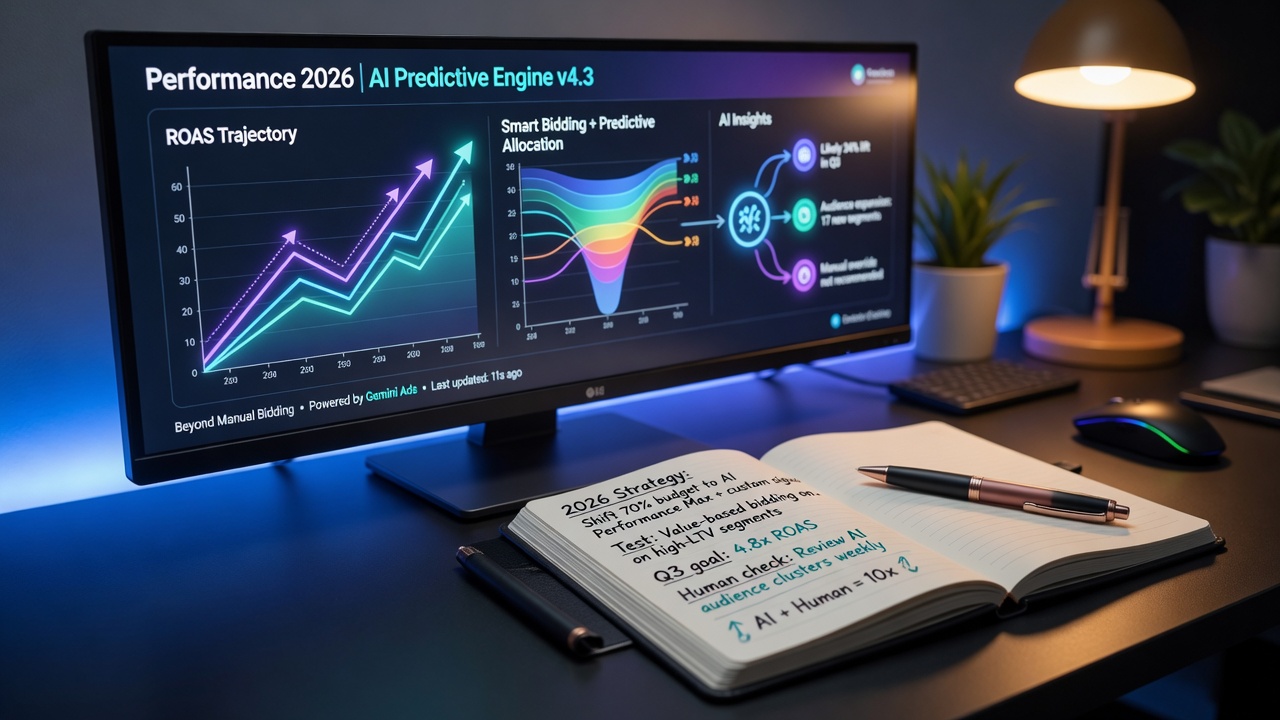
Beyond Manual Bidding: Mastering Google Ads and Analytics in the AI-Driven Era of 2026
For over a decade, the hallmark of a skilled PPC (Pay-Per-Click) manager was their ability to micromanage. Success meant obsessing over exact-match keywords, manually adjusting cost-per-click (CPC) bids by pennies, and meticulously building hundreds of tightly themed ad groups. If you weren’t in the account every day, you were losing money.
That era is officially dead.
As we navigate 2026, Google’s advertising ecosystem has undergone a fundamental, irreversible shift toward artificial intelligence and machine learning. The platform is no longer a manual lever you pull; it is a complex, autonomous engine you guide. In fact, Performance Max campaigns now drive an estimated 45% of all Google Ads conversions, signaling a massive platform-wide shift toward automated, goal-based bidding [[5]].
For marketers and business owners, this presents a critical choice: you can either fight the algorithm and watch your costs spiral, or you can learn to harness it. The winners in 2026 are not the ones who bid the highest; they are the ones who feed the AI the best data, the clearest goals, and the most compelling creative assets. Here is the data-backed blueprint for mastering Google Ads and Analytics in the modern era.
The Performance Max Reality: Co-Pilot, Not Autopilot
When Google launched Performance Max (PMax), many advertisers treated it as a “set it and forget it” magic button. They dumped in a budget, threw in some generic assets, and waited for the sales to roll in. The result was often disastrous: wasted spend on low-quality display placements and irrelevant search queries.
However, the data shows that when properly configured, PMax is highly efficient. Recent benchmarking indicates that optimized Performance Max campaigns are actually driving down average Cost Per Acquisition (CPA) compared to traditional search campaigns, with some sectors seeing CPA reductions of nearly 7% year-over-year [[7]].
The Fix: Treat PMax as a co-pilot, not an autopilot. The algorithm is only as smart as the guardrails you build around it.
- Feed It High-Quality Audience Signals: Do not rely on Google to guess your customer. Upload your first-party customer lists (past purchasers, high-value leads) as “audience signals” to guide the algorithm toward your most profitable demographics from day one.
- Negative Keyword Lists at the Account Level: While PMax limits query-level control, you can and must apply account-level negative keyword lists to prevent your ads from showing for completely irrelevant, brand-damaging, or overly broad terms.
- Asset Group Segmentation: Do not lump all your products or services into one giant asset group. Create distinct asset groups for distinct themes (e.g., “Running Shoes” vs. “Hiking Boots”) with tailored headlines, descriptions, and images for each.
First-Party Data is Your New Moat (The Post-Cookie Reality)
The deprecation of third-party cookies is no longer a future threat; it is the current reality. Relying on third-party tracking pixels to follow users across the web is a dying strategy, leading to degraded attribution and rising acquisition costs.
In this privacy-first environment, first-party data (data you collect directly from your customers with their consent) is your primary survival tool [[20]]. It is the only data source that is 100% accurate, privacy-compliant, and immune to browser restrictions. The financial impact is stark: marketers who effectively leverage first-party data audiences in their PPC campaigns report an average 38% improvement in Return on Ad Spend (ROAS) [[12]]. Today, 84% of leading marketers prioritize first-party data collection as a core strategy [[18]].
The Fix: Build your own data fortress.
- Implement Enhanced Conversions: Ensure Google Ads Enhanced Conversions is active. This feature securely hashes first-party data (like email addresses) from your website and sends it to Google, significantly improving conversion tracking accuracy in a cookieless world.
- Incentivize Zero-Party Data: Create lead magnets, quizzes, or loyalty programs that encourage users to voluntarily share their preferences and contact information. This “zero-party” data is even more valuable than standard first-party data because the user explicitly told you what they want.
- Utilize Consent Mode V2: If you operate in or target users in Europe, ensure your website is fully compliant with Google’s Consent Mode V2. This allows Google to model missing conversion data for users who decline cookies, preventing a catastrophic drop in your reported analytics.
GA4 Predictive Metrics: Moving From Vanity Metrics to Future Forecasting
For years, digital marketers obsessed over “vanity metrics”: pageviews, bounce rates, and session duration. While Google Analytics 4 (GA4) still tracks these, its true power lies in its AI-driven predictive capabilities.
GA4 uses advanced machine learning models to analyze historical user behavior and identify patterns that humans would miss. It can automatically generate metrics like “Purchase Probability” (the likelihood a user will buy in the next 7 days) and “Churn Probability” (the likelihood an active user will not return). The strategic value of this is undeniable: 59% of marketing professionals agree that GA4’s predictive metrics have significantly improved their campaign targeting accuracy [[25]].
The Fix: Stop just reporting on what happened; start acting on what will happen.
- Build Predictive Audiences: In GA4, create an audience of users with a “High Purchase Probability.” Export this audience directly to Google Ads and apply a higher bid multiplier to this specific group. You are now paying more to reach the people the AI has already identified as ready to buy.
- Target At-Risk Users: Create a “High Churn Probability” audience and serve them a specific retargeting campaign featuring a limited-time discount or a re-engagement offer to pull them back from the brink.
- Verify Your Data Foundation: Predictive metrics require a critical mass of data to be accurate. Ensure your GA4 property is registered as a “Key Event” (formerly conversion) and that you are generating at least 1,000 of these events per month to activate the machine learning models.
The Creative Mandate: Why Your Assets Matter More Than Your Keywords
In the old days of exact-match keywords, the copywriter’s job was to stuff the target keyword into the headline. Today, with broad match and AI-driven targeting, the search engine is inferring intent based on a multitude of signals. The primary lever you have left to influence the algorithm and capture user attention is your creative.
Google’s AI will test thousands of combinations of your headlines, descriptions, images, and videos. If your creative assets are generic, low-resolution, or fail to address a specific customer pain point, the algorithm will quickly learn that your ads do not convert, and it will stop showing them (or charge you a premium for the privilege).
The Fix: Adopt a “creative-first” media buying strategy.
- Diversify Your Formats: Do not just upload static images. Provide Google with a mix of landscape, square, and portrait images, along with at least one high-quality, short-form video (even a simple 15-second product demo). PMax heavily favors accounts that provide video assets.
- Write for Humans, Not Robots: Focus your headlines on clear value propositions, urgency, and specific benefits. Instead of “Best CRM Software,” use “Close Deals 30% Faster with Automated CRM.”
- Audit Asset Performance: Regularly review the “Asset Strength” and individual asset performance reports in Google Ads. Ruthlessly pause the images and headlines that are rated “Low” or “Learning,” and replace them with fresh, hypothesis-driven variations.
Sources & References
- [5] Digital Applied. (2026). Google Ads Performance Max 2026: Campaign Guide. Performance Max campaigns drive 45% of Google Ads conversions. Retrieved from digitalapplied.com
- [7] Get Ryze AI. (2026). Cost Per Acquisition Benchmarks 2026: Google Ads (Performance Max) average CPA trends and optimization data. Retrieved from get-ryze.ai
- [12] Digital Applied. (2026). PPC Statistics 2026: 38% Improvement in ROAS when using first-party data audiences. Retrieved from digitalapplied.com
- [18] Salesforce. (2026). Marketing Statistics: 84% of marketers use first-party data as a core strategy. Retrieved from salesforce.com
- [20] LinkedIn / Industry Analysis. (2025/2026). The Future of PPC Attribution: First-party data is your primary survival tool in the privacy-first era. Retrieved from linkedin.com
- [25] DigiWizard. (2026). Google Analytics for Businesses: 59% of marketing professionals agree that GA4’s predictive metrics have improved campaign targeting accuracy. Retrieved from digiwizard.ie
The Bottom Line
Mastering Google Ads and Analytics in 2026 is no longer about outsmarting the platform with manual tricks. It is about building a robust, privacy-compliant data foundation, feeding the AI clear, high-quality signals, and relentlessly testing human-centric creative. The algorithm will handle the heavy lifting of bidding and placement. Your job is to provide the strategy, the story, and the steering. Embrace the shift, and your paid search performance will scale in ways the old manual playbook could never achieve.
