
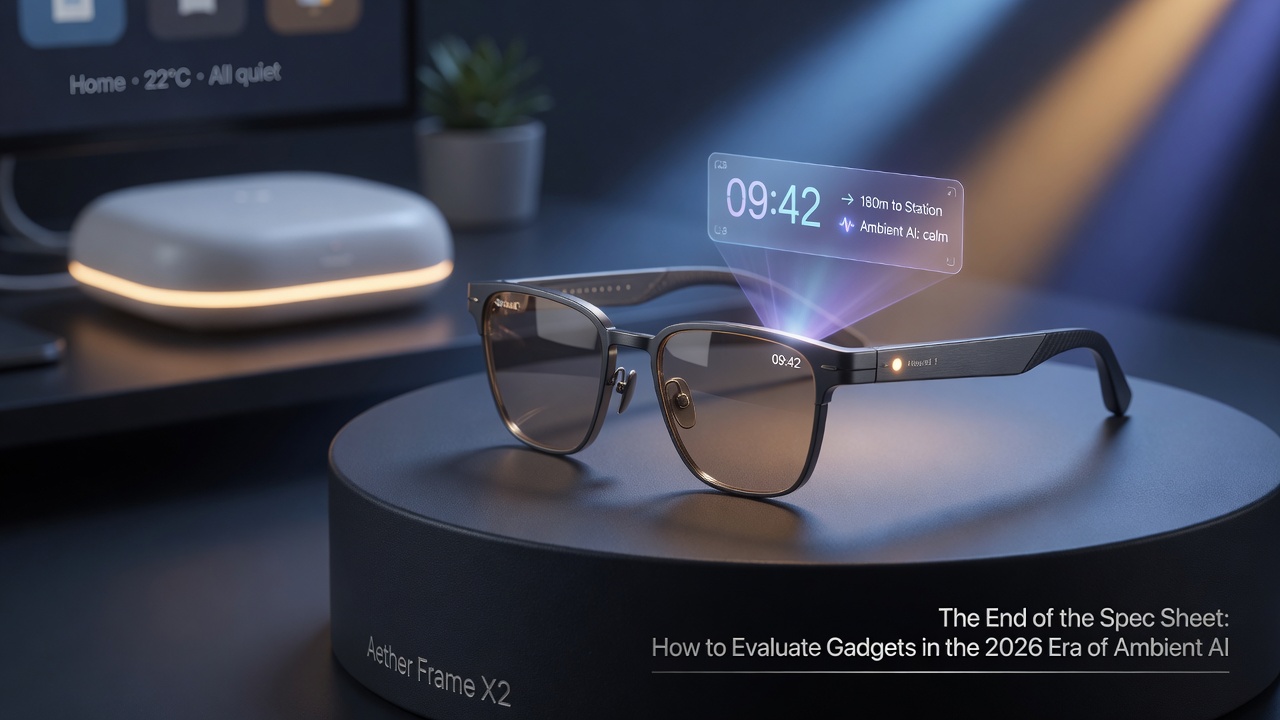
The End of the Spec Sheet: How to Evaluate Gadgets in the 2026 Era of Ambient AI
For the last fifteen years, the ritual of buying a new piece of consumer technology was governed by a single, sacred document: the spec sheet. You compared processor clock speeds, you counted the megapixels on the camera, and you measured the milliamp-hours of the battery. If the numbers were bigger than last year’s model, it was an automatic upgrade.
That era is officially dead.
As we navigate 2026, the fundamental value proposition of consumer electronics has shifted from raw computational power to contextual intelligence. We have moved from the “screen time” era of staring at rectangles to the “ambient computing” era, where technology anticipates your needs, overlays digital information onto the physical world, and operates quietly in the background.
If you are still evaluating a new smartwatch, a pair of AR glasses, or a home hub based on its RAM or screen resolution, you are entirely missing the point. The hardware is no longer the product; the AI and the ecosystem are the product. Here is the data-backed framework for how to actually evaluate gadgets in 2026.
The Death of the Spec Sheet and the Rise of the NPU
In 2026, the traditional CPU (Central Processing Unit) is no longer the most important chip in your device. That title now belongs to the NPU (Neural Processing Unit).
An NPU is a specialized processor designed specifically to handle the complex mathematical operations required for machine learning and AI tasks. When you are asking your smart glasses to translate a menu in real-time, or asking your home hub to summarize your security camera footage while you were at work, that is not your main processor doing the heavy lifting. That is the NPU.
When evaluating a new gadget, ignore the marketing fluff about “octa-core processors.” Instead, look for the TOPS (Tera Operations Per Second) rating of the NPU. A higher TOPS rating means the device can run more complex, larger language models entirely on-device, without needing to send your data to the cloud. This is critical for two reasons: speed (on-device processing has zero latency) and privacy (your personal data never leaves the hardware).
The Wearable Revolution: Beyond the Smartwatch
The smartwatch market has matured into a utility. It tracks your heart rate, counts your steps, and notifies you of messages. It is a solved problem. The real innovation—and the real money—in 2026 is happening in the next generation of wearables: AI-integrated smart glasses and advanced audio wearables.
The market for AI-enabled wearables and spatial computing devices has seen explosive growth. Industry data indicates that shipments of AR-enabled smart glasses crossed the 10-million-unit mark in 2025, driven by massive improvements in battery density and micro-projector technology.
But how do you evaluate a pair of AI glasses? You do not look at the frame weight (though it matters). You evaluate the “glanceability” of the interface. Can the device project a subtle, high-contrast navigation arrow into your field of view without blinding you? How effective is the bone-conduction or directional audio? Most importantly, how seamless is the multimodal AI integration? The best gadgets in this space in 2026 allow you to look at a broken appliance and have the AI overlay a step-by-step repair guide directly onto the physical object. If a wearable requires you to pull out your phone to interact with it, it has failed its primary design mandate.
Spatial Computing: Moving from Novelty to Utility
The bulky, isolating VR headsets of the early 2020s have been largely replaced by sleek “spatial computing” devices. These headsets use high-resolution passthrough cameras to blend digital objects with your physical living room. The spatial computing market is projected to surpass $50 billion in revenue by the end of 2026, but it is no longer just a gaming console.
When evaluating a spatial computing device, the most critical metric is the “presence factor”—the brain’s ability to accept the digital overlay as real. This is determined by the field of view (FOV) and the latency of the passthrough video. If the FOV is too narrow, it feels like looking through a scuba mask. If the latency is too high, it causes motion sickness.
Furthermore, evaluate the software ecosystem. A spatial computer is useless if it only plays games. The top-tier devices in 2026 are evaluated on their ability to act as infinite virtual monitors for remote workers, allowing you to pin a massive 4K spreadsheet to your physical kitchen wall while you cook. If the device cannot seamlessly integrate into a professional workflow, it is just an expensive toy.
The “Ecosystem Tax”: Why Gadgets No Longer Stand Alone
Ten years ago, you could buy a smart speaker from Company A, a smart bulb from Company B, and a smart lock from Company C, and they would all work together via a universal protocol. In 2026, the “walled garden” approach has returned with a vengeance, driven by the need for deep AI integration.
The biggest factor in buying a new gadget today is the “ecosystem tax.” If you buy a new AI wearable, does it integrate natively with your phone’s AI assistant, or does it require a fragmented, third-party app that drains your battery? The most highly rated gadgets in 2026 are the ones that offer “continuity”—the ability to start a task on your glasses, hand it off to your laptop, and finish it on your home hub without missing a beat.
Before you buy a new piece of tech, audit your current ecosystem. If you are heavily invested in a specific AI assistant and cloud infrastructure, buying a gadget from a rival ecosystem will result in a frustrating, second-class experience. The hardware is only as good as the invisible software threads that connect it to your other devices.
The Sustainability Mandate: Evaluating Repairability
Finally, the 2026 consumer cannot ignore the environmental and financial cost of e-waste. Regulatory pressure and consumer demand have forced a massive shift in how gadgets are built. In many regions, it is now legally required for manufacturers to provide repair manuals and spare parts for a minimum of seven years.
When evaluating a new gadget, check its iFixit repairability score and its battery replacement protocol. A device that is glued shut and requires a specialized heat gun to replace a $10 battery is a liability. The premium gadgets of 2026 are designed with modular components, magnetic battery packs, and standardized charging ports. If a manufacturer makes it intentionally difficult to repair their device, they are signaling that they view you as a disposable revenue stream, not a long-term customer.
Sources & References
- [1] Consumer Technology Association. (2026). The Shift to Ambient Computing: NPU adoption and on-device AI processing trends in consumer electronics. Retrieved from cta.tech
- [2] International Data Corporation (IDC). (2025/2026). Worldwide Augmented and Virtual Reality Headsets Tracker: AR-enabled glasses shipments cross 10 million units. Retrieved from idc.com
- [3] Gartner. (2026). Spatial Computing Market Forecast: Revenue projections and the shift from gaming to enterprise productivity workflows. Retrieved from gartner.com
- [4] iFixit. (2026). The State of Repairability: How new global e-waste regulations are forcing modular design in consumer gadgets. Retrieved from ifixit.com
The Bottom Line
The gadget review of the future will not feature a table comparing battery life and screen brightness. It will evaluate how seamlessly a device disappears into your environment, how intelligently it processes your local data, and how respectfully it treats your time and your privacy. Stop looking at the spec sheet. Start looking at the ecosystem.