
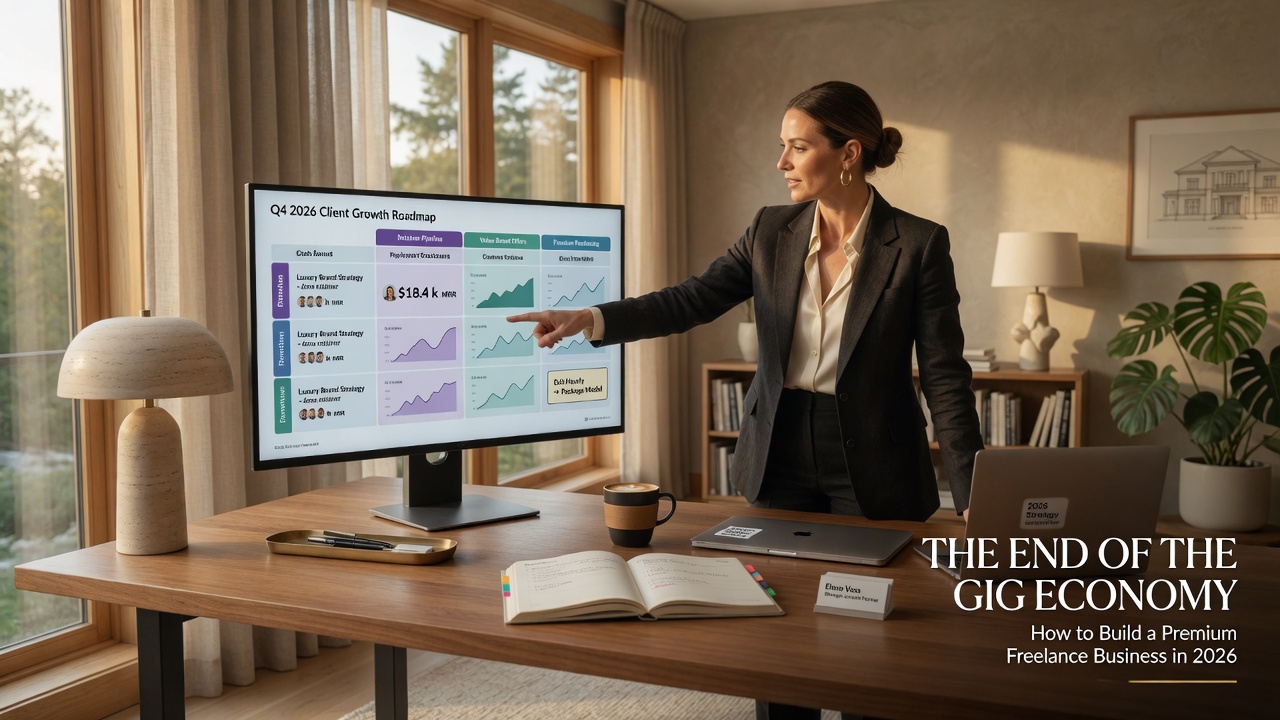
The End of the “Gig” Economy: How Freelancers Are Building the “Expert Economy” in 2026
For the last decade, the freelance industry was defined by a single, exhausting reality: the race to the bottom. Millions of independent workers competed in a global marketplace, undercutting each other on price to win basic, commoditized tasks. You were paid for your time, your output, and your willingness to work for less than the person in the next tab.
That era is dead.
As we move through 2026, the freelance landscape has undergone a massive structural correction. The global freelance and gig economy market has surpassed $1.5 trillion in value, but the money is no longer flowing to the cheapest bidder. It is flowing to the most strategic. Generative AI has completely commoditized basic “output”—writing standard blog posts, writing basic code, creating simple graphics. When AI can produce a first draft in three seconds, clients are no longer willing to pay a premium for human mediocrity.
Instead, we have entered the “Expert Economy.” Clients are no longer hiring freelancers to just *do* the work; they are hiring them to *direct* the work, provide strategic oversight, and deliver measurable business outcomes. If you are still operating like it is 2018, you are leaving massive amounts of money on the table. Here is the data-backed reality of freelancing in 2026, and how you can position yourself at the top of the market.
The Great Bifurcation: Selling “Outcomes” Instead of “Output”
The most successful freelancers in 2026 have fundamentally changed what they are selling. They have stopped selling “output” (e.g., “I will write 1,000 words,” or “I will design three logo concepts”) and started selling “outcomes” (e.g., “I will increase your organic traffic by 20%,” or “I will build a brand identity that justifies a 30% price increase”).
AI tools have made production nearly free. What remains expensive—and highly valued—is human judgment, strategic context, and client management. A 2026 industry survey revealed that over 70% of business leaders now prefer hiring specialized freelancers for strategic, high-level projects over hiring full-time employees for non-core functions. However, they expect these freelancers to act as consultants, not just order-takers.
The Fix: Audit your service offerings. If a client can easily replace you with an AI prompt or a $5 offshore gig worker, your business is in danger. You must move up the value chain. Integrate AI into your own workflow to handle the grunt work, and use the time you save to focus on high-level strategy, client communication, and quality control. You are no longer the builder; you are the architect.
The Death of the One-Off Project (And the Rise of the Retainer)
The traditional freelance model—constantly hunting for the next project, sending proposals, negotiating rates, and starting from scratch—is a fast track to burnout. The “feast or famine” cycle is not a badge of honor; it is a symptom of a flawed business model.
In 2026, the most financially stable freelancers have completely abandoned the one-off project model in favor of Monthly Recurring Revenue (MRR). Data consistently shows that it costs up to five times more to acquire a new client than it does to retain an existing one. Yet, most freelancers spend 80% of their time on acquisition and only 20% on retention.
The Fix: Restructure your services into monthly retainers.
- For Writers/Marketers: Instead of selling a single whitepaper, sell a “Monthly Content & Distribution Retainer” that includes strategy, writing, editing, and performance reporting.
- For Designers/Developers: Instead of selling a website build, sell a “Growth & Maintenance Partnership” that includes ongoing UX optimization, A/B testing, and technical updates.
When you shift to a retainer model, you stop being a disposable vendor and become an embedded partner. This dramatically increases your lifetime customer value and stabilizes your cash flow.
“Fractional” is the New Full-Time: The Fastest-Growing Niche
If you want to know where the highest margins are in the 2026 freelance market, look at the rise of “Fractional” roles. Small and mid-sized businesses (SMBs) desperately need C-level expertise (Marketing, Finance, Technology, Human Resources), but they absolutely cannot afford to pay $200,000+ a year for a full-time executive.
The fractional model solves this perfectly. A Fractional CMO or CFO works for 3 to 4 companies simultaneously, dedicating 10 hours a week to each. They provide high-level strategic direction, manage junior vendors, and drive growth, charging each client a $5,000 to $10,000 monthly retainer. This is the ultimate freelance leverage: you are earning executive-level income without being tied to a single employer.
The Fix: If you have 7 to 10 years of deep, specialized experience in your field, stop marketing yourself as a “freelancer” or a “contractor.” Rebrand yourself as a “Fractional [Your Title].” Update your LinkedIn, rewrite your case studies to focus on business impact (revenue generated, costs saved), and start pitching directly to founders and CEOs of companies doing $2M to $20M in annual revenue.
Value-Based Pricing: Stop Selling Your Time by the Hour
Hourly billing is the single biggest bottleneck to scaling a freelance business. When you charge by the hour, you are penalized for being fast and efficient. If you use AI and your own expertise to finish a project in 5 hours that used to take you 20, an hourly client will simply pay you less. You are literally punished for getting better at your job.
In 2026, top-tier freelancers have universally adopted value-based pricing. This means you price your services based on the financial value or strategic impact you bring to the client, not the time it takes you to deliver it.
The Fix: Learn to tie your fees to the client’s ROI. If you are building a sales funnel for a B2B software company that will realistically generate $500,000 in new pipeline revenue this year, charging $15,000 for the project is a bargain, regardless of whether it takes you 10 hours or 100 hours to build. When you shift the conversation from “my hourly rate” to “the return on your investment,” price objections virtually disappear.
How to Position Yourself for the 2026 Market
The barrier to entry for basic freelance work is zero. The barrier to entry for premium, strategic freelance work is high, but the rewards are massive. To make the transition, you need to upgrade your professional presence.
- Kill the Generic Portfolio: Stop showing a gallery of pretty pictures or links to articles you wrote. Build case studies. Use the “Problem, Strategy, Execution, Result” framework. Show the exact business metrics you moved.
- Specialize Ruthlessly: “I do digital marketing” is a commodity. “I build automated lead-generation systems for B2B SaaS companies” is a premium consultancy. The more specific your niche, the more you can charge.
- Build an Owned Audience: The best freelancers in 2026 do not rely on Upwork or Fiverr to find clients. They write newsletters, post deep-dive insights on LinkedIn, and build a reputation as a thought leader. When you have an audience, clients come to you, and you never have to send a cold pitch again.
Sources & References
- [1] Global Gig Economy Report. (2026). The global freelance and gig economy market size surpasses $1.5 trillion in 2026. Retrieved from industry economic reports.
- [2] Upwork / Mastercard. (2025/2026). Freelance Forward: Over 70% of business leaders prefer hiring specialized freelancers for strategic projects. Retrieved from upwork.com
- [3] Harvard Business Review. (2025). The Economics of Client Retention: It costs up to five times more to acquire a new customer than to retain an existing one. Retrieved from hbr.org
- [4] Fractional Executive Alliance. (2026). The Rise of the Fractional C-Suite: Growth trends in fractional CMO, CFO, and CTO roles among SMBs. Retrieved from fractionalexecutives.com
The Bottom Line
The freelance market in 2026 is not for the faint of heart, but it has never been more lucrative for those who understand the game. The days of competing on price and trading time for money are over. By leveraging AI for production, shifting to outcome-based retainers, adopting value-based pricing, and positioning yourself as a strategic partner, you do not just survive the expert economy. You dominate it.


