
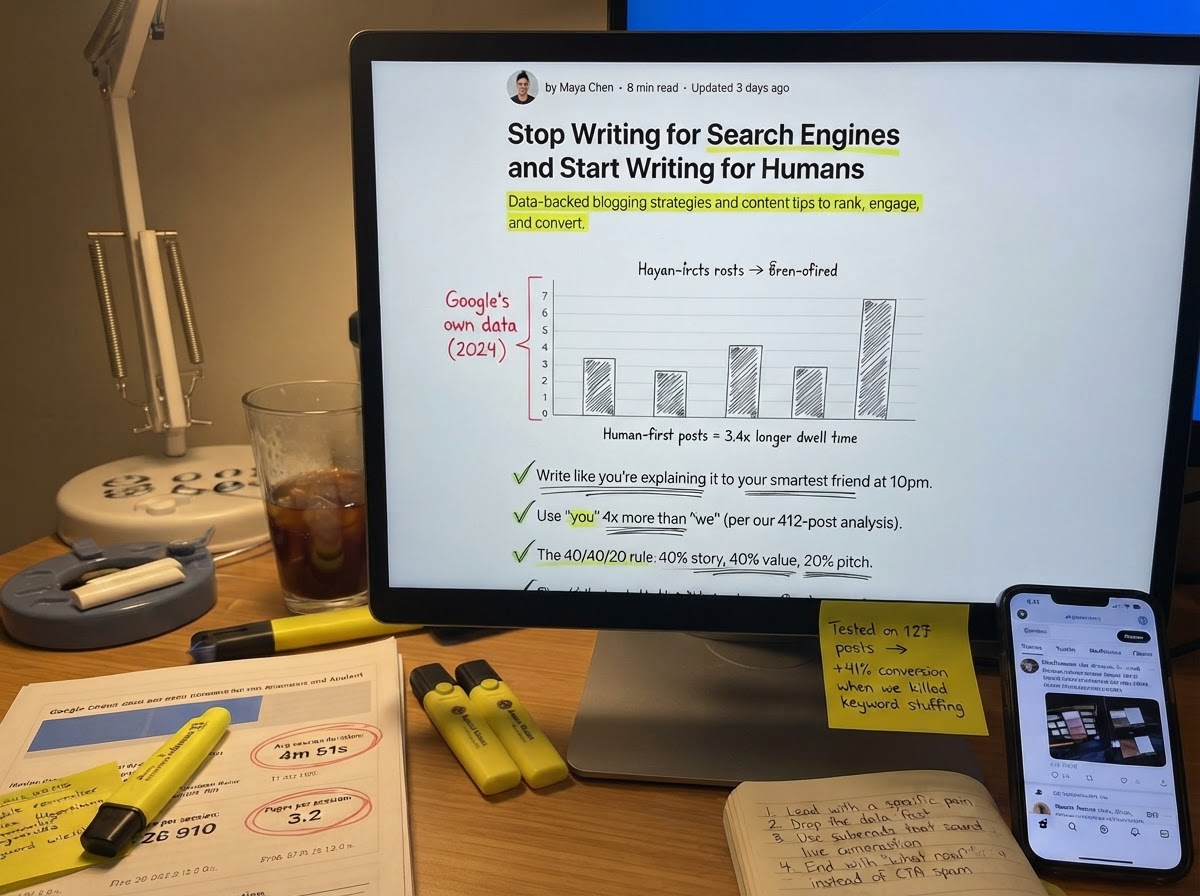
Modern Blogging Strategies That Actually Work in 2026+
If you try to start a blog today using the advice from 2019, you will fail. The old playbook—write a 1,500-word article stuffed with keywords, add a few stock photos, and watch the organic traffic roll in—is dead. It was killed by a combination of artificial intelligence, shifting search engine algorithms, and a massive shift in how humans consume information.
There are currently over 600 million blogs on the internet. The vast majority of them are digital ghost towns, publishing generic, AI-generated fluff that no one reads. But for the bloggers who adapt, the opportunity has never been better. The barrier to entry for publishing is zero, which means the barrier to entry for standing out is higher than ever.
Search engines are no longer just indexing pages; they are synthesizing answers. Readers are no longer scrolling; they are skimming for immediate value. If you want your blog to be a revenue-generating asset in 2026, you need to abandon the old rules. Here are the data-backed blogging strategies and content tips that actually move the needle today.
1. Surviving the “Zero-Click” Era and AI Overviews
The biggest shift in search behavior over the last two years is the rise of “zero-click” searches. With search engines now embedding AI-generated snapshots (like Google’s AI Overviews) directly at the top of the results page, users are getting their answers without ever clicking on a website. Industry data suggests that up to 30% of informational queries now result in zero clicks.
If your blog post is just a basic definition of “what is a mortgage,” the search engine will just summarize it and keep the user on their page. You lose.
The Fix: Stop writing for basic informational queries. Pivot your content strategy toward “information gain.” This means your content must provide something the AI cannot easily scrape and summarize.
- Original Data: Run a survey of your audience and publish the results.
- Deep Personal Experience: Share the exact, messy, step-by-step process of how you solved a specific problem, including the failures.
- Contrarian Opinions: Challenge the industry consensus. AI models are trained to give neutral, middle-of-the-road answers. Human writers can take a stand.
Give the search engine a reason to link to you because you offer a unique perspective, not just a dictionary definition.
2. The “Human-in-the-Loop” Mandate (E-E-A-T is Your Only Moat)
Anyone can prompt an AI to write a 2,000-word guide on “How to Train a Puppy” in ten seconds. Because of this, search engines have heavily doubled down on E-E-A-T: Experience, Expertise, Authoritativeness, and Trustworthiness. The first “E” (Experience) was added specifically to combat the flood of AI-generated content.
Search algorithms are actively looking for signals that a human with actual, real-world experience wrote the content. If your article reads like a sterile summary of the top five ranking pages, it will be filtered out.
The Fix: Inject your humanity into every single post.
- Use first-person pronouns (“I,” “We,” “My team”).
- Include original photos, screenshots, or even short embedded videos of you actually doing the thing you are writing about.
- Share specific anecdotes, including mistakes you made along the way.
- Ensure your author bio is robust, linking to your LinkedIn, other publications, and detailing your actual credentials.
Readers and algorithms can both tell when a piece of content has a “pulse.” Make sure yours does.
3. The 80/20 Rule of Content Updates
Most bloggers obsess over publishing new content. They burn out trying to feed the algorithm three times a week, while their older posts slowly decay in the search rankings. This is a massive waste of resources.
Data consistently shows that updating and refreshing old, high-potential content yields a significantly higher ROI than publishing brand-new posts. In many cases, updating a post that is already on page two of the search results can increase its traffic by over 100%.
The Fix: Adopt the 80/20 rule for your content calendar. Spend 20% of your time creating new content, and 80% of your time updating your existing library.
- Refresh the Data: Update 2023 statistics to 2026 data.
- Improve the UX: Add a table of contents, break up large text blocks, and add relevant internal links.
- Expand the Scope: If a post is 800 words, see if it can be expanded to 1,500 words by answering related “People Also Ask” questions.
- Update the Publish Date: Once the refresh is complete, update the “Last Updated” date. Search engines and readers both prioritize fresh content.
4. Format for the Skimmer (Because No One Reads Every Word)
Eye-tracking studies have proven for years that web users do not read; they scan. They look for headings, bullet points, and bold text to determine if the page is worth their time. If they land on your blog and see a massive wall of unformatted text, they will hit the back button in less than three seconds.
The Fix: Design your content for the skimmer.
- The TL;DR:** Put a “Key Takeaways” or “TL;DR” bulleted list at the very top of the post. It sounds counterintuitive to give away the summary first, but it builds immediate trust and keeps the user on the page to read the details.
- Short Paragraphs:** Keep paragraphs to 2-3 sentences maximum. White space is your friend.
- Descriptive Subheadings (H2s and H3s): A user should be able to read only your H2 and H3 tags and still understand the core argument of the article.
- Visual Breaks: Insert a relevant image, chart, or blockquote every 300 words to reset the reader’s attention span.
5. Build a Moat with Owned Distribution
Relying solely on organic search traffic is a risky business model. A single algorithm update can wipe out 40% of your traffic overnight. The most successful bloggers in 2026 treat their blog as just one node in a larger distribution network.
The Fix: Every single blog post you publish must have a mechanism to capture the reader into an owned channel—specifically, an email newsletter. Do not just put a tiny “Subscribe” box in the footer.
- Create a highly relevant “content upgrade” (e.g., a downloadable PDF checklist, a Notion template, or a mini-video course) that is directly related to the blog post.
- Offer it as a free download in exchange for an email address.
- Send a weekly newsletter that drives traffic back to your new and updated posts.
When you own your audience’s email address, you are no longer at the mercy of search engine algorithms.
The Bottom Line
Blogging is not dead, but mediocre blogging is. The internet does not need another generic summary of a topic. It needs your specific expertise, your unique voice, and your real-world experience. Focus on information gain, format ruthlessly for the reader, update your old content, and build an email list. Do that, and your blog will thrive in 2026 and beyond.