
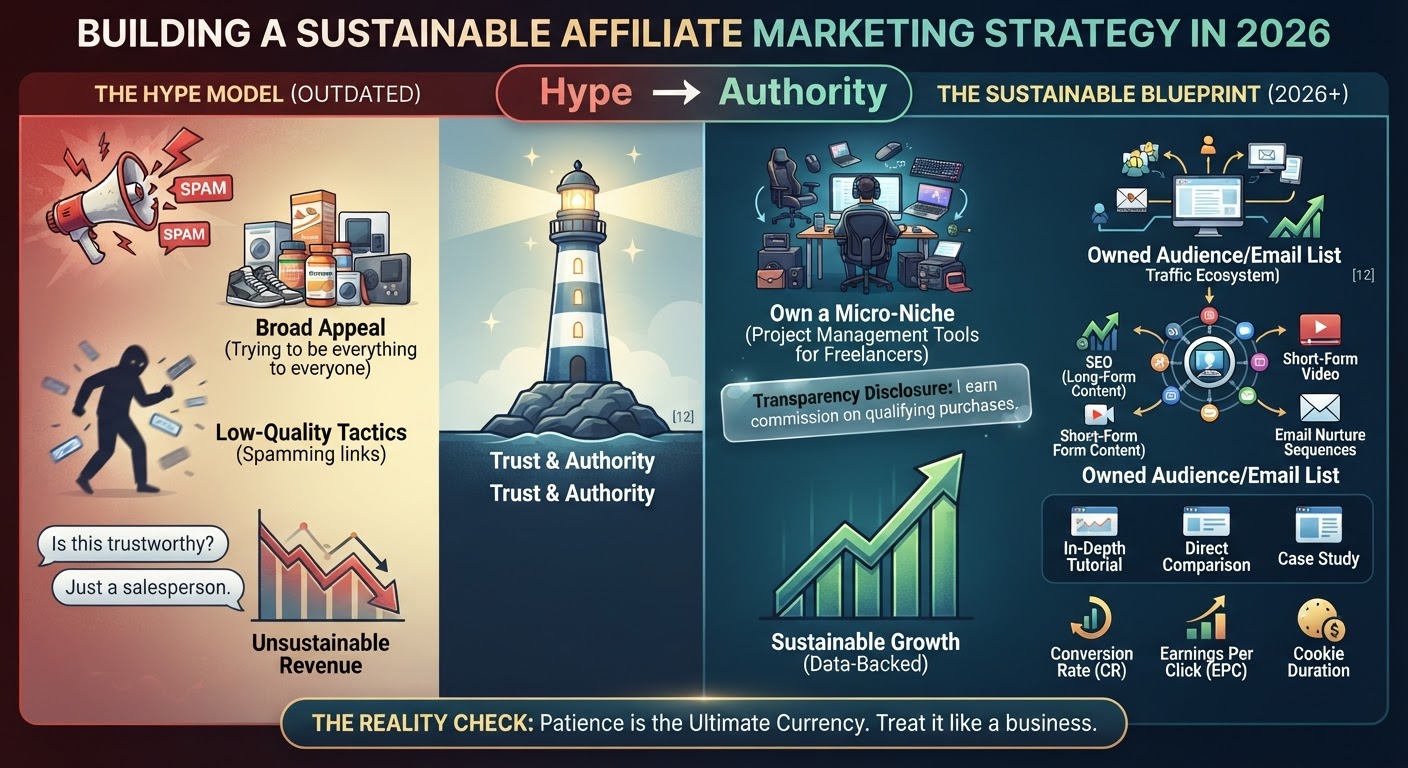
Building a Sustainable Affiliate Marketing Strategy in 2026
If you have spent more than five minutes online, you have seen the promise: “Make $10,000 a month in passive income with affiliate marketing while you sleep!” The reality is far less glamorous, but significantly more achievable for those willing to treat it like a real business.
The days of spamming low-quality links in blog comments or posting generic product lists are over. Search engines have gotten smarter, and consumers have become highly skeptical of inauthentic recommendations. Yet, the industry itself is thriving. The global affiliate marketing industry size is estimated at just over $20 billion in 2026, up from roughly $17 to $18.5 billion in 2025 [[1]]. Furthermore, 57% of marketers are actively increasing their investment in affiliate channels, recognizing its high return on investment compared to traditional advertising [[10]].
The money is still there, but the rules have changed. Success in 2026 requires a shift from “spray and pray” tactics to building genuine, trust-based authority. Here is the data-backed blueprint for building a sustainable affiliate marketing strategy that actually lasts.
1. Niche Authority Beats Broad Appeal Every Time
The biggest mistake new affiliates make is trying to be everything to everyone. A website reviewing “the best tech, the best camping gear, and the best makeup” will struggle to rank in search engines and will fail to build a loyal audience. Google’s recent algorithm updates heavily favor “Experience, Expertise, Authoritativeness, and Trustworthiness” (E-E-A-T).
The Fix: Drill down until it hurts. Instead of “fitness equipment,” focus on “home gym setups for small apartments.” Instead of “software reviews,” focus on “project management tools for freelance graphic designers.” When you own a micro-niche, you face less competition, and your audience views you as a specialized expert rather than a generic salesperson. This specialization directly impacts your bottom line, as studies show that 62% of online shoppers are more likely to make a purchase after seeing an affiliate link from a source they perceive as a trusted authority [[12]].
2. Radical Transparency Is Your Best Conversion Tool
Audiences are not stupid. They know you are making a commission when they click your link. Trying to hide this fact destroys trust instantly. Conversely, being upfront about your affiliate relationships can actually increase your conversion rates.
When you explicitly state, “I receive a small commission if you buy through this link, which helps keep this site running at no extra cost to you,” you accomplish two things: you comply with FTC (or local) disclosure regulations, and you frame the transaction as a mutually beneficial support system rather than a deceptive trick.
The Fix: Place clear, plain-language disclosures at the top of your content, not buried in a footer. More importantly, only promote products you have personally used or thoroughly researched. If a product has a flaw, mention it. A review that highlights a minor drawback is exponentially more believable than a review that claims a product is “absolutely perfect in every way.”
3. Diversify Your Traffic Sources (The Algorithm Trap)
Relying on a single platform for your affiliate traffic is a massive vulnerability. If you build your entire business on YouTube, a single algorithm change or account suspension can wipe out your income overnight. The same applies to relying solely on organic SEO or a single social media platform like TikTok or Instagram.
The Fix: Build an owned audience. While you should absolutely leverage SEO and social media to attract new visitors, your primary goal should be to move those visitors onto an email list or a community platform (like a Discord server or private newsletter) that you control.
- SEO: For long-term, compounding organic traffic (e.g., “Best X for Y” articles).
- Short-form Video: For top-of-funnel brand awareness and quick product demonstrations.
- Email Marketing: For nurturing leads, sharing exclusive deals, and driving repeat conversions from an audience that already trusts you.
4. Focus on “Value-First” Content Formats
Posting a banner ad or a naked affiliate link rarely works anymore. You must provide value before asking for the click. The most successful affiliate content solves a specific problem for the user.
High-Converting Content Formats:
- In-Depth Tutorials: “How to Set Up a Home Recording Studio for Under $500.” You naturally link to the microphone, interface, and software as part of the solution.
- Direct Comparisons: “Tool A vs. Tool B: Which is Better for Beginners?” These capture high-intent search traffic from people who are already close to making a purchasing decision.
- Case Studies: “How I Saved 10 Hours a Week Using [Software].” Real-world results are the most powerful sales copy you can write.
5. Track the Metrics That Actually Matter
It is easy to get distracted by vanity metrics like page views or total clicks. While traffic is necessary, it does not pay the bills. To build a sustainable business, you must analyze the data that reflects actual performance.
Key Metrics to Monitor:
- Conversion Rate (CR): The percentage of clicks that result in a sale. If you have high traffic but a CR below 1%, your audience does not trust your recommendation, or the landing page you are sending them to is poorly optimized.
- Earnings Per Click (EPC): This tells you the average value of every single click you send to a merchant. It helps you identify which affiliate programs are actually worth your time, regardless of the commission percentage.
- Cookie Duration: A 24-hour cookie means you only get paid if the user buys immediately. A 30- to 90-day cookie gives the user time to think, vastly increasing your chances of getting credit for the sale.
The Reality Check: Patience Is the Ultimate Currency
Affiliate marketing is not a get-rich-quick scheme; it is a get-rich-slow business. It typically takes 6 to 12 months of consistent, high-quality content creation before you see significant organic traffic and meaningful revenue. During this “ghost town” phase, most people quit.
The affiliates who succeed are the ones who treat the first year as an investment phase. They focus on building a library of helpful content, growing an email list, and refining their understanding of their audience’s pain points.
The Bottom Line
The $20 billion affiliate marketing industry is not going anywhere, but the barrier to entry for quality is higher than ever. Stop looking for loopholes or magic software. Pick a micro-niche, be radically transparent, create content that genuinely solves problems, and diversify your traffic. Do that consistently, and you will build an asset that pays dividends for years to come.