
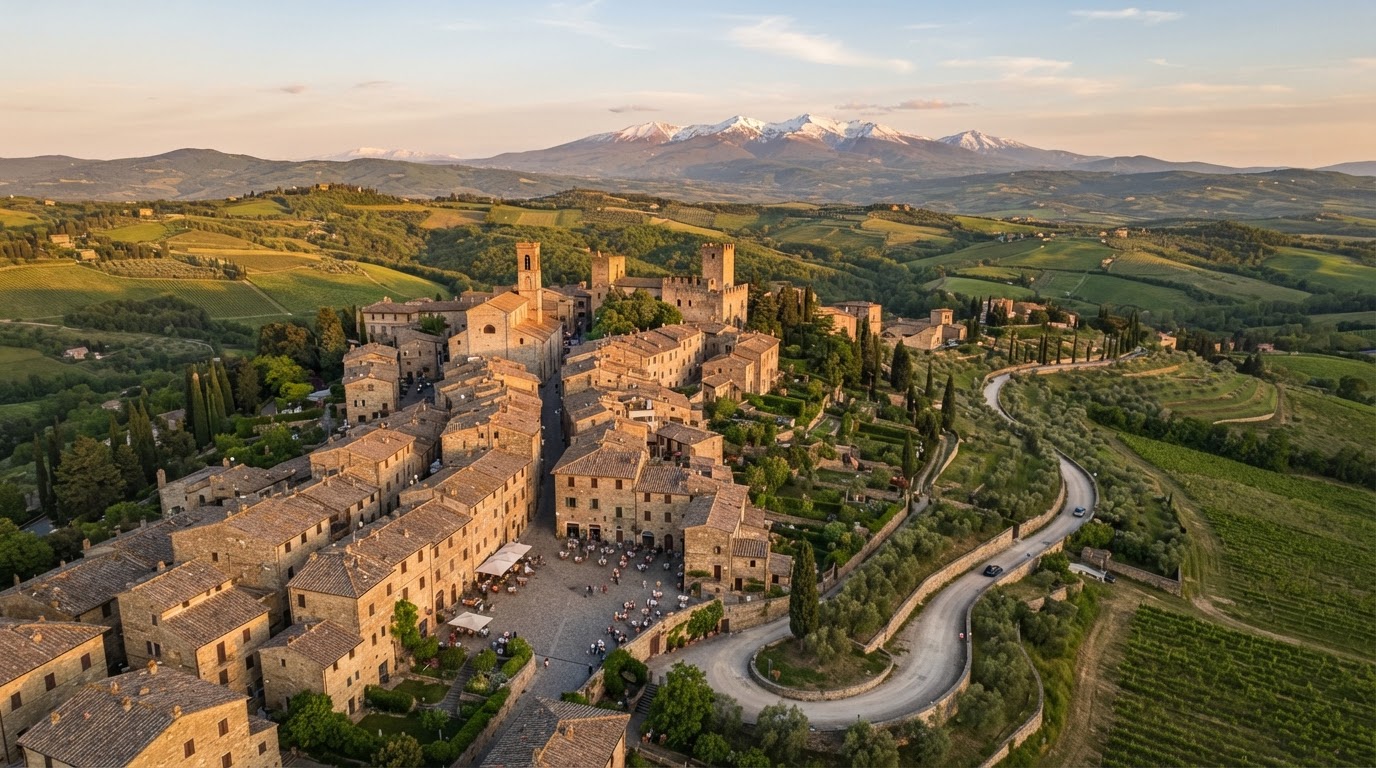
Beyond the Capitals: The Data-Backed Reality of Country Life in Europe in 2026
The postcard dream of moving to Europe usually involves a cramped, overpriced apartment in Paris, a noisy scooter-filled street in Rome, or fighting through crowds of tourists in Barcelona. For years, expats and digital nomads flocked to these major cultural hubs, willing to pay a premium for the “European lifestyle.”
But in 2026, that premium has become unsustainable. Skyrocketing urban rents, aggressive overtourism, and the normalization of remote work have triggered a massive demographic shift. Expats are no longer just looking at capital cities; they are looking at the countryside. They are trading 400-square-foot urban studios for sprawling stone farmhouses, and the data shows this is not just a romantic fantasy—it is a highly calculated economic move.
If you are considering country life in Europe, you need to look past the Instagram filters. Here is the data-backed reality of rural European living, the hidden economics, and the legal pathways to get you there.
The “Empty Europe” Phenomenon: Why Villages Actually Want You
While European capitals are bursting at the seams, the countryside is quietly emptying out. A recent analysis of European Union data revealed a staggering demographic reality: half of Europe’s towns and villages currently have fewer residents than they did 60 years ago [[3]].
This rural depopulation is most acute in Southern Europe. In Spain, a phenomenon known locally as “España Vaciada” (Empty Spain) has resulted in a bizarre geographic imbalance where 90% of the country’s population lives on just 2% of the land [[2]]. The Spanish National Statistics Institute recently counted nearly 3.8 million vacant homes across the country, many sitting abandoned in rural provinces [[5]].
For an expat, this demographic crisis is your greatest leverage point. Local municipalities are desperate to reverse this brain drain and are actively rolling out the welcome mat for foreign remote workers and entrepreneurs. In 2026, various rural repopulation programs are offering incredible incentives, with some villages in provinces like Soria literally offering rent-free homes and jobs to essential workers and remote professionals willing to commit to the community [[4]]. Expats are increasingly recognized as a vital lifeline to revitalize these historic, yet emptying, rural areas [[6]].
The Economics: Urban vs. Rural Cost of Living
The primary driver pushing remote workers out of European cities and into the countryside is simple math. The cost of living for remote workers in major European capitals now routinely exceeds €3,000 a month, whereas affordable inland and rural areas can offer a high quality of life for roughly €1,200 a month [[9]].
Let us break down the housing disparity. In the center of Madrid, Lisbon, or Milan, a standard one-bedroom apartment can easily consume 50% to 70% of a median remote salary. Conversely, data from rural remote-work communities shows that rent for a one-bedroom apartment in the European countryside can average around $400 per month [[11]].
This creates a massive geographic arbitrage opportunity. If you are earning a US, UK, or Northern European salary, living in rural Portugal, Southern Italy, or inland Spain allows you to save aggressively, eat out daily, and hire local help for home maintenance, all while living in a multi-bedroom house with a garden. The continuous tendency for workers to suburbanize or move rurally is heavily driven by these punishing housing prices in core cities [[12]].
The Infrastructure Reality Check (The “Catch”)
It is not all cheap wine, slow mornings, and sunshine. Moving to the European countryside requires a brutal honesty about infrastructure. The success of any rural repopulation plan depends entirely on whether the services necessary for a modern, decent life can be restored to communities from which they were gradually withdrawn [[7]].
Before signing a lease or buying a “1 Euro house,” you must audit the following:
- Internet Connectivity: Do not trust a village’s claim of “broadband.” You need to verify the exact Mbps upload and download speeds at the specific address. While fiber optics are expanding rapidly across rural Europe, many stone cottages have thick walls that block cellular signals, requiring you to invest in a mesh Wi-Fi system or a Starlink satellite dish.
- Healthcare Access: Rural clinics (consultorios) often only operate a few hours a week. You must calculate the exact driving distance to the nearest major hospital with an English-speaking staff and an emergency room. In many rural regions, this could be a 45-minute drive.
- The Language Barrier: In Berlin or Amsterdam, you can survive indefinitely on English. In rural Andalusia or the Italian Apennines, English proficiency drops to near zero among the older population. You will need to learn the local language not just for socializing, but to negotiate with plumbers, deal with local bureaucracy, and buy groceries.
Visas and Legal Pathways for the Countryside
A common misconception is that visas are tied to specific cities. They are not. If you are approved for a national visa, you are generally free to live wherever you want within that country’s borders.
- Digital Nomad Visas (DNV): Countries like Spain, Portugal, and Italy have launched DNVs that allow you to live and work remotely. Because these visas require you to prove a minimum monthly income (often between €2,500 and €3,500), that income stretches exponentially further in a rural village than it would in a capital city, making it much easier to qualify for and maintain.
- Passive Income Visas: If you are a retiree, a freelancer with seasonal income, or living off investments, Spain’s Non-Lucrative Visa (NLV) or Portugal’s D7 Visa are ideal. These explicitly prohibit you from working for local companies, making them perfectly suited for quiet, low-cost country life where your passive income guarantees a luxurious standard of living.
How to Test the Waters Before Committing
The biggest mistake expats make is buying property sight-unseen based on romanticized YouTube videos. Rural Europe in July is a paradise; rural Europe in November can be damp, isolated, and freezing if the property lacks central heating (which many historic homes do).
The 3-Month Rental Rule: Before committing to a long-term lease or a property purchase, commit to a three-month rental during the “shoulder season” (October to December, or February to April). This forces you to experience the village when the tourist infrastructure is closed, the weather is unpredictable, and the reality of daily rural chores sets in. Use this time to test the internet reliability, meet the local mayor, and figure out if the silence of the countryside is actually what you want.
The Bottom Line
Country life in Europe in 2026 is no longer just a retirement plan; it is a highly strategic lifestyle choice for remote workers and young families. By leveraging the “Empty Europe” demographic shift, you can secure incredible real estate, integrate into tight-knit communities, and reclaim your financial freedom. Just ensure you do your due diligence on the infrastructure, respect the local language, and test the waters before you plant your flag.