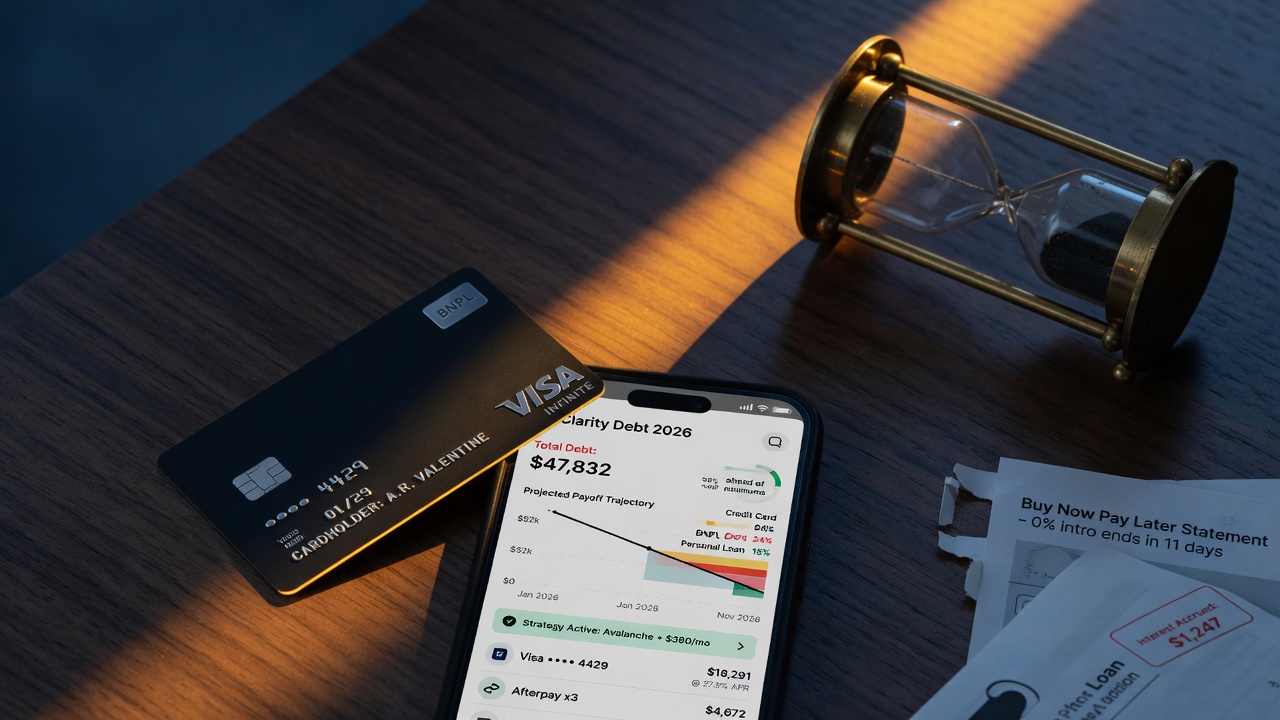
The Debt Dilemma in 2026: Navigating Credit Cards, BNPL, and Personal Loans in a High-Rate World
For the better part of the 2010s, borrowing money felt essentially free. Interest rates were historically low, credit was easily accessible, and the cultural narrative heavily favored leveraging debt to maximize lifestyle or investment returns. That era of cheap money has definitively closed, and the hangover is now showing up on consumer balance sheets across the country.
As we move through 2026, the reality of the modern borrowing landscape is stark. U.S. households are carrying an estimated $1.33 trillion in credit card debt, a staggering figure that reflects the compounding pressure of persistent inflation and elevated interest rates [[10]]. The days of carrying a balance with a 9% APR are long gone, replaced by a mathematical environment where poor debt management can rapidly destroy personal wealth.
However, debt itself is not inherently evil; it is simply a financial tool. The difference between financial ruin and strategic leverage lies entirely in how you manage the cost of capital. Whether you are navigating a mountain of credit card balances, tempted by the frictionless checkout of Buy Now, Pay Later (BNPL) services, or considering a personal loan for consolidation, you need a modern playbook. Here is the data-backed reality of consumer borrowing in 2026, and how to engineer your way out of the high-rate trap.
The $1.33 Trillion Credit Card Reality (and the APR Trap)
The most critical metric in the credit card industry today is not the rewards points or the sign-up bonus; it is the Annual Percentage Rate (APR). In Q2 2026, the average APR across all credit cards hovered around 20.94%, with many retail and subprime cards pushing well past 22.15% [[1]], [[5]].
To understand how punishing this is, consider the math: if you carry a $10,000 balance at a 22% APR and only make the minimum payments, it will take you over 30 years to pay off the debt, and you will pay more than $25,000 in interest alone. The credit card companies are not making their record profits from the 2% cash back they give you; they are making it from the compounding interest charged to the roughly 45% of cardholders who carry a balance month-to-month.
The Strategic Fix: If you are carrying high-interest credit card debt, your absolute priority must be to lower your blended interest rate immediately.
- The Balance Transfer Pivot: If you have a credit score above 670, aggressively pursue a 0% introductory APR balance transfer card. These offers typically last 15 to 21 months. Transfer your highest-interest debt to this card, but treat the promotional period as a strict countdown clock. Divide your total balance by the number of months and automate that exact payment to clear the debt before the standard rate kicks in.
- The Negotiation Tactic: A surprising number of consumers do not realize that APRs are negotiable. If you have a history of on-time payments, call your card issuer’s retention department and politely ask for a temporary rate reduction. Industry data suggests that simply asking can yield a 2% to 5% APR drop, saving you hundreds of dollars over the year.
The BNPL Boom and the Hidden Delinquency Crisis
If credit cards are the traditional heavyweights of consumer debt, Buy Now, Pay Later (BNPL) services like Affirm, Klarna, and Afterpay are the rapid-growth challengers. Originally marketed as a harmless way to split small retail purchases into four interest-free payments, BNPL has morphed into a massive, systemic credit force.
The adoption rates are staggering. Recent surveys indicate that 72% of Americans now use BNPL services, representing a massive 20% jump in adoption from 2025 [[17]]. Globally, the BNPL market transaction value hit approximately $560 billion in 2025, fundamentally altering the e-commerce checkout experience [[12]].
But this frictionless borrowing comes with a hidden psychological and financial cost. Because BNPL loans often do not report to major credit bureaus in the same way traditional loans do, consumers easily lose track of their total obligations. This “stacking” of micro-loans leads to severe cash flow crunches. According to recent industry trackers, a shocking 47% of BNPL users report paying late on at least one loan in the past year [[13]]. Late fees on BNPL platforms can quickly eclipse the cost of traditional credit, and missed payments are increasingly being reported to collections agencies, devastating credit scores.
The Strategic Fix: Stop treating BNPL as a “discount” or a “hack.” It is a short-term, unsecured loan.
- The 24-Hour Rule: Never use BNPL for impulse purchases at the digital checkout. If you want an item, add it to your cart and wait 24 hours. If you still want it, check if you have the cash to pay for it outright.
- Reserve for High-Utility Purchases: Only use zero-interest BNPL offers for necessary, high-cost items that provide immediate utility (like a replacement laptop for work or a major appliance), and only if you have the total cash sitting in your bank account, preferring to keep your cash liquid for the 6-week duration.
The Personal Loan Pivot: Consolidation vs. Lifestyle Inflation
When credit card debt becomes unmanageable, the personal loan market often looks like a life raft. The global personal loan market is expanding rapidly, projected to grow from $429 billion in 2025 to over $1.09 trillion as consumers seek quick financial solutions for debt consolidation [[30]].
Currently, the average personal loan interest rate sits between 12.28% and 14.90% for standard 3-year terms [[21]], [[22]]. While this is significantly lower than the 22% APR of a credit card, it is still a premium cost of capital. Furthermore, the stress on the consumer wallet is showing in the delinquency data: an estimated 3.81% of personal loan borrowers were 60 days or more past due in Q2 2026, a notable increase from previous years [[23]].
The danger of the personal loan is “lifestyle inflation.” Many consumers take out a $15,000 personal loan to pay off their maxed-out credit cards, but fail to change their spending habits. Six months later, they have a $15,000 personal loan payment plus $8,000 in new credit card debt. They have not solved the problem; they have merely doubled their monthly obligations.
The Strategic Fix: A personal loan should only be used as a tactical strike against high-interest debt, not as a funding source for vacations, weddings, or discretionary spending.
- Close the Revolving Accounts: The moment the personal loan funds hit your account and pay off your credit cards, call the credit card issuers and lower your credit limits to $1,000, or lock the cards in a physical drawer. Remove them from Apple Pay, Google Pay, and your browser autofill to introduce deliberate friction into your spending habits.
- Calculate the Break-Even: Before signing the promissory note, calculate the total interest paid over the life of the personal loan versus the credit cards. If the personal loan comes with heavy origination fees (often 3% to 8% of the loan amount), it may negate the benefit of the lower APR. Always compare the Annual Percentage Rate (APR), which includes fees, not just the base interest rate.
3 Non-Negotiable Rules for Borrowing in 2026
To survive and thrive in a high-rate environment, you must adopt a ruthless, mathematical approach to your liabilities.
1. Automate the “Debt Destroyer” Transfer
Willpower is a finite resource, and manually transferring money to your debt every month leaves room for hesitation. Set up an automatic transfer from your primary checking account to your highest-interest debt account for the exact same day your paycheck clears. Treat this debt payment as a mandatory tax, not an optional bill.
2. Guard Your Credit Utilization Ratio
Your credit score is heavily influenced by your utilization ratio—the amount of credit you are using compared to your total limits. If you have $10,000 in total credit limits and carry a $5,000 balance, your utilization is 50%, which will drag your score down and result in higher insurance premiums and worse loan rates. Aim to keep your aggregate utilization below 10%, and never let a single card exceed 30% of its individual limit.
3. Never Borrow to Invest or Speculate
In the zero-interest-rate era, some investors used margin or personal loans to buy stocks or crypto, hoping the asset appreciation would outpace the loan interest. In 2026, with borrowing costs exceeding 12% to 20%, the math makes this incredibly dangerous. Only borrow for assets that inherently appreciate or generate income (like real estate or education), never for speculative market bets.
Sources & References
- [1] LendingTree. (2026). 2026 Credit Card Debt Statistics: For all credit cards, the average APR in Q2 2026 was 20.94%. Retrieved from lendingtree.com
- [5] WalletHub. (2026). Credit Card Debt Statistics for 2026: Average APR on Debt is 22.15%. Retrieved from wallethub.com
- [10] WalletHub / TransUnion Data. (2026). U.S. households had $1.33 trillion in credit card debt at the end of early 2026. Retrieved from wallethub.com
- [12] Chargeflow. (2026). $560B BNPL Market in 2026: Global BNPL market reached approximately $560.1 billion in 2025. Retrieved from chargeflow.io
- [13] LendingTree. (2026). BNPL Tracker: 47% of buy now, pay later users say they’ve paid late on a loan in the past year. Retrieved from lendingtree.com
- [17] PartnerCentric. (2026). Latest 2026 BNPL Usage Trends Report: 72% of Americans now use BNPL. Retrieved from partnercentric.com
- [21] Bankrate. (2026). Best Personal Loan Rates for October 2026: The average personal loan interest rate is 12.28%. Retrieved from bankrate.com
- [22] Credible. (2026). Personal Loan Interest Rates in 2026: Average personal loan rates are 14.90% for 3-year loans. Retrieved from credible.com
- [23] LendingTree. (2026). Personal Loan Statistics: An estimated 3.81% of personal loan borrowers are 60 days or more past due as of Q2 2026. Retrieved from lendingtree.com
- [30] BHG Financial / Fortune Business Insights. (2026). Global personal loan market is expected to grow from $429.78 billion in 2025 to over $1.09 trillion. Retrieved from bhgfinancial.com
The Bottom Line
The financial landscape of 2026 does not forgive the careless borrower. With credit card APRs punishing the complacent and the frictionless ease of BNPL masking the true weight of consumer obligations, managing debt requires intense vigilance. By ruthlessly attacking high-interest balances, treating micro-loans with the respect they demand, and using personal loans strictly for strategic consolidation, you can reclaim your cash flow and turn debt from a master back into a manageable tool.