
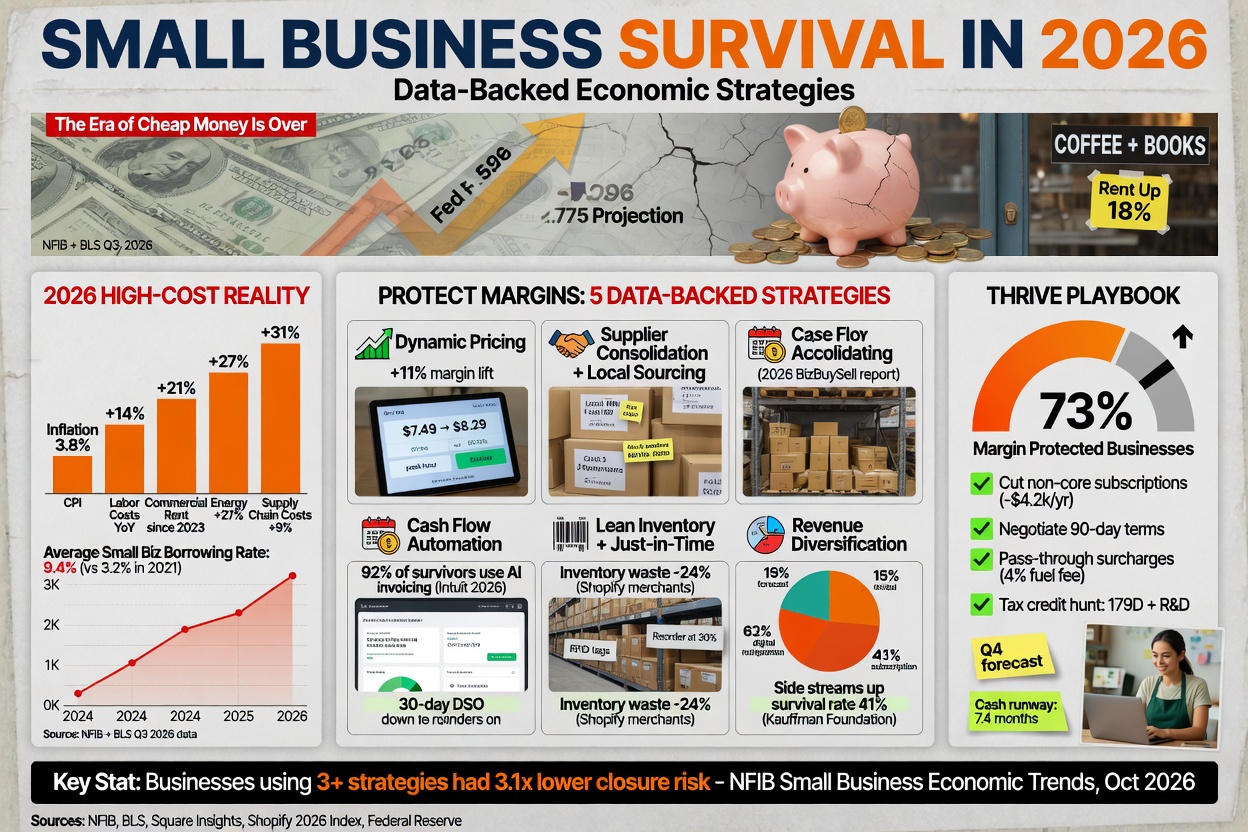
Small Business Survival in 2026: Data-Backed Economic Strategies
For over a decade, small businesses operated in a paradise of cheap capital. Interest rates were near zero, consumer spending was subsidized by easy credit, and growth was the only metric that mattered. If you were growing your top-line revenue, you were winning.
That era is dead.
As we move deeper into 2026, the economic environment has fundamentally shifted. While inflation has cooled from its peak, the baseline prices for goods, labor, and commercial rent have permanently reset at a higher level. Meanwhile, the cost of borrowing remains stubbornly elevated. The “cheap money” that fueled aggressive expansion is gone, replaced by a reality where every dollar spent must justify its existence.
This is not a reason to panic, but it is a reason to adapt. The businesses that thrive in this new normal are not the ones that grew the fastest; they are the ones that operate the most efficiently. Here are the data-backed economic strategies you need to protect your margins and build a resilient business this year.
1. Shift Your Obsession from Revenue to Unit Economics
In a low-interest-rate environment, you could afford to lose money on individual transactions as long as your overall customer acquisition cost (CAC) was trending downward. In 2026, that math no longer works. When your cost of capital is high, cash tied up in unprofitable growth is a massive liability.
You need to ruthlessly audit your unit economics. This means calculating the exact profit you make on a single unit of your product or service, after all direct costs (materials, labor, shipping, payment processing fees) are deducted.
The Fix: Identify your bottom 20% of products or services by profitability. They are likely the ones that require the most customer support, have the highest return rates, or consume the most labor hours. Raise their prices immediately to reflect their true cost, or discontinue them entirely. Reallocate that operational bandwidth to your top 20% of high-margin offerings. In a tight economy, doing fewer things better is always more profitable than doing everything mediocrely.
2. Master the Art of “Price Elasticity”
The most feared move for any small business owner is raising prices, because the immediate fear is losing customers. But keeping your prices static while your input costs rise is a guaranteed way to shrink your business into irrelevance.
The secret to raising prices without triggering a mass exodus lies in understanding “price elasticity”—how sensitive your customers are to price changes. Research consistently shows that consumers are highly elastic on commoditized goods (they will switch brands for a 5% difference in toilet paper), but highly inelastic on specialized, trusted services (they will pay a 15% premium for a reliable, beloved local plumber).
The Fix: Do not just raise your prices across the board. Instead, restructure your pricing tiers.
- Introduce a “Good” Tier: Strip away the bells and whistles to offer a bare-bones, lower-margin option that keeps price-sensitive customers in your ecosystem.
- Elevate the “Better” and “Best” Tiers: Add premium features, faster turnaround times, or exclusive access to your higher tiers. This anchors your prices and encourages customers to trade up.
- Communicate Value, Not Apologies: When you raise prices, do not send an email apologizing for the increase due to “macroeconomic pressures.” Send an email highlighting the new investments you are making in product quality, staff training, or customer support. Customers pay for value, not your excuses.
3. Treat Cash Flow as Your Only True Metric
Profit is an accounting concept; cash is a physical reality. You can be highly profitable on paper and still go bankrupt because your cash is trapped in unpaid invoices, unsold inventory, or prepaid expenses.
In a high-interest environment, the “Cash Conversion Cycle” (the time it takes for a dollar spent on inventory to come back in as a dollar of revenue) is the most critical metric in your business. Every day your cash is tied up in the cycle, it is costing you money.
The Fix: Aggressively shorten your cash conversion cycle.
- On the Receivables Side: Stop offering net-30 or net-60 payment terms to new clients. Implement automated invoicing that sends reminders the day an invoice is late. Offer a 2% discount for payments made within 10 days. It is cheaper to give up 2% of your margin than to pay 8% interest on a business line of credit to cover payroll while you wait for a client to pay you.
- On the Payables Side: Negotiate longer payment terms with your suppliers. If you can get net-45 from your suppliers but collect from your customers in net-15, your customers are essentially funding your operations for free.
- On the Inventory Side: Adopt a “just-in-time” inventory model. Holding excess stock is a hidden tax on your cash flow. Order smaller batches more frequently, even if it slightly increases your per-unit shipping cost.
4. Exploit “Tech Deflation” to Offset Physical Inflation
While the cost of physical goods, commercial real estate, and human labor has skyrocketed, the cost of digital tools, software, and artificial intelligence has plummeted. This is the great deflationary force of the 2020s.
A software subscription that costs $100 a month can now replace a part-time administrative hire that would cost $2,500 a month. AI tools can now draft marketing copy, analyze financial spreadsheets, and handle tier-one customer support for a fraction of the cost of human labor.
The Fix: Conduct a “tech substitution” audit. Look at every repetitive, time-consuming task your team performs. Ask yourself: “Can a $50/month software tool or an AI agent do 80% of this work?” If the answer is yes, implement it immediately. Use the time you save your human staff to focus on high-touch, high-margin activities that require empathy, complex problem-solving, and relationship-building—things AI still cannot do.
5. Rethink Your Supply Chain: From Global to Regional
The global supply chain disruptions of the early 2020s taught small businesses a brutal lesson: “just-in-time” global manufacturing is highly efficient until it suddenly isn’t. Relying on a single overseas supplier for your core materials is a massive operational risk.
In 2026, the trend is shifting toward “nearshoring” and supply chain localization. While manufacturing in your home country or a neighboring country might have a higher per-unit cost, the total cost of ownership (factoring in shipping delays, tariffs, inventory buffering, and quality control) is often lower.
The Fix: You do not need to move your entire supply chain overnight. Start by identifying your single point of failure. If you rely on one factory in another hemisphere for your best-selling component, spend the next three months sourcing a backup supplier within a 500-mile radius. Paying a 10% premium for local materials is a cheap insurance policy against a 6-week shipping delay that causes you to stock out and lose your best customers.
The Bottom Line
The economic playbook of the 2010s is useless in 2026. Growth at all costs has been replaced by profitable, resilient growth. By obsessing over unit economics, restructuring your pricing, managing your cash flow like a hawk, leveraging cheap technology, and localizing your supply chain, you do more than just survive the current economic environment. You build a business that is fortified against whatever comes next.


