
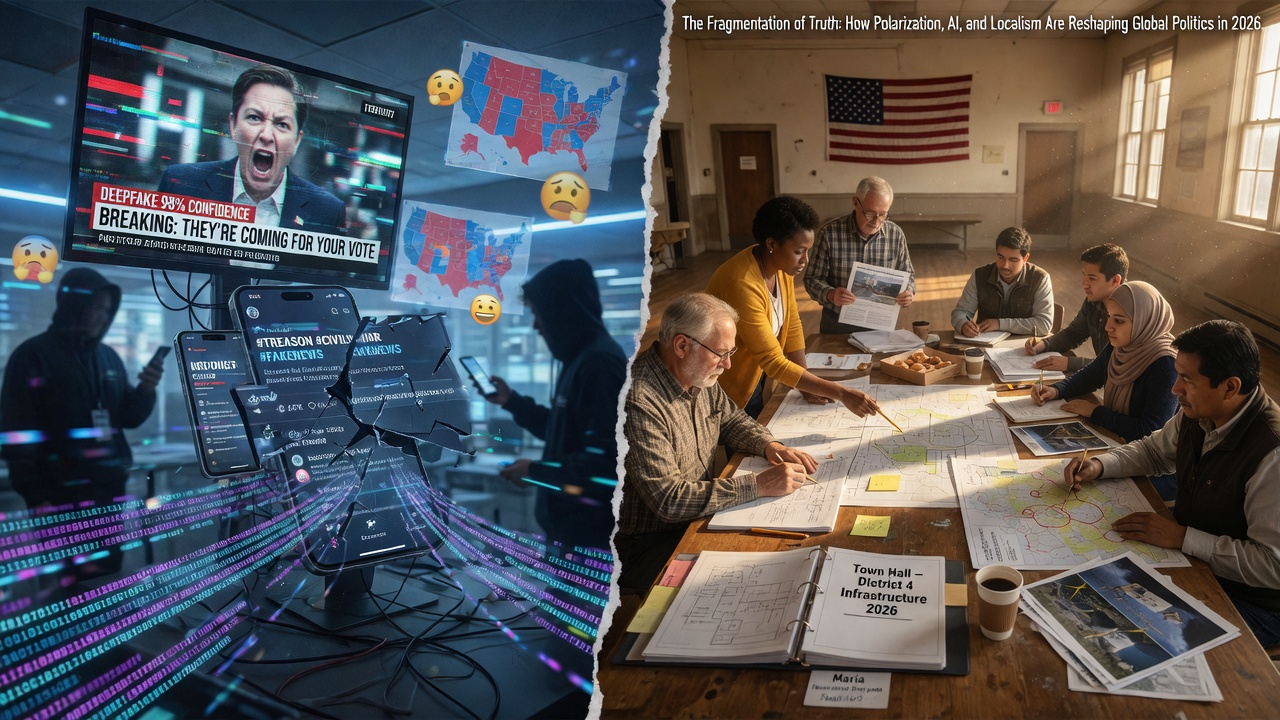
The Fragmentation of Truth: How Polarization, AI, and Localism Are Reshaping Global Politics in 2026
For much of the late 20th century, the foundational assumption of democratic politics was that while citizens might disagree on policy, they generally shared a common baseline of reality. You could debate tax rates or foreign policy, but you agreed on the basic facts of the world.
That shared reality has fractured.
As we move through the major electoral cycles of 2026, the global political landscape is being fundamentally rewired by three colliding forces: a historic collapse in institutional trust, the weaponization of artificial intelligence, and a profound shift in how younger generations choose to engage with their communities. Politics is no longer just a debate over how to allocate resources; it has become an existential battleground over truth, identity, and survival.
Yet, beneath the noise of national outrage, a quiet, highly effective counter-movement is taking root at the municipal level. To understand where global politics is heading, we have to look past the cable news chyrons and examine the data. Here is the definitive, data-backed breakdown of the political realities defining 2026.
The Trust Deficit: Why National Institutions Are Losing Their Grip
If there is a single defining metric of modern politics, it is the evaporation of public trust. The 2026 Edelman Trust Barometer, the premier global study on institutional faith, paints a stark picture: trust in national government continues a troubling, multi-year plunge [[21]]. In fact, across the 28 countries surveyed, government ranked as the least trusted institution, trailing behind business, NGOs, and the media [[27]].
This is not merely a case of voters being unhappy with the current administration; it is a structural rejection of the national political apparatus. Citizens increasingly view federal and national governments as corrupt, inefficient, or entirely captured by special interests. The World Economic Forum’s Global Risks Report 2026 explicitly identifies “societal and political polarization” as a top-tier threat, noting that economic bifurcation is intensifying this divide and leaving societies on the edge [[8]].
However, this national distrust is inadvertently creating a vacuum that is being filled by a surprising source: local relationships. The Edelman report highlights a crucial pivot, noting that trust is moving closer to home, with faith in local government and community leaders ranking significantly higher than national counterparts [[21]]. People may not trust a senator they have never met, but they trust the city council member who fixed the pothole on their street.
The AI Election Threat: Deepfakes and the War on Reality
The 2024 global election cycle was widely considered a “stress test” for artificial intelligence. By 2026, that stress test has evolved into an active, ongoing cyber-warfare environment. AI deepfakes have shifted from being a novelty or a niche hacking tool to a mainstream method of political influence and cybercrime [[17]].
The threat is no longer just about a highly realistic, fake video of a candidate confessing to a crime days before an election—though that remains a severe risk. The deeper, more insidious threat is what security experts call the “Liar’s Dividend.” As AI-generated synthetic media floods the internet, the mere existence of deepfakes allows bad actors to dismiss genuine, documented scandals or real audio recordings as “AI fakes.”
Researchers have exposed how this technology actively threatens elections by eroding the very concept of objective evidence [[13]]. When voters cannot trust their own eyes and ears, the default psychological response is cynicism and withdrawal. Disinformation campaigns in 2026 do not necessarily need to convince you that a specific lie is true; they only need to generate enough synthetic noise to convince you that the truth is unknowable. This exhaustion is a highly effective tool for voter suppression.
Affective Polarization: The Death of the Middle
Political scientists distinguish between “ideological polarization” (disagreeing on tax policy) and “affective polarization” (actively despising the other side). In 2026, affective polarization is the dominant force in global democracies.
Data from the V-Dem Institute tracks the extent to which societies are divided into hostile, mutually antagonistic political camps [[1]]. This hostility is eroding longstanding bipartisan consensus, even on critical issues like foreign policy and national security [[7]]. The political center has not just shrunk; it has been hollowed out by algorithmic incentives that reward outrage and punish nuance.
For the average citizen, this creates a toxic environment where political identity is treated as a moral absolute. Compromise is viewed as betrayal, and the opposition is viewed not as a political rival, but as an existential threat to the nation. This dynamic paralyzes national legislatures, leading to endless government shutdowns, gridlock, and a reliance on executive orders that are immediately reversed by the next administration.
The Localist Revival: How Gen Z is Rewiring Civic Engagement
Given the toxicity of national politics, it is tempting to assume that the electorate is simply giving up. The data shows the exact opposite is happening, particularly among younger demographics. Millennials and Gen Z are not abandoning democracy; they are bypassing the broken national system entirely and focusing their energy where they can actually see results.
Recent polling reveals that Gen Z voters are increasingly choosing specific issues over rigid political party affiliations [[29]]. They are highly skeptical of the two-party system and the political “gerontocracy” that has dominated the landscape for decades. In response, organizations dedicated to recruiting young people for local office are seeing massive surges in engagement, driven by the realization that older generations are unlikely to willingly pass down power [[37]].
Furthermore, research from Tufts University highlights that young people disproportionately trust peers, local government, and institutions they can physically see taking action in their communities [[30]]. Gen Z is highly engaged in community-related activities, local protests, and municipal boards, recognizing that zoning laws, local environmental regulations, and school board decisions have a more immediate impact on their daily lives than debates in the national capital [[31]], [[34]].
3 Actionable Strategies for the 2026 Citizen
Navigating the political landscape in 2026 requires a defensive posture toward your attention and a proactive posture toward your community. Here is how to stay engaged without losing your mind.
1. Practice “Information Dieting” and Source Triangulation
Algorithmic feeds are designed to trigger your amygdala, keeping you in a state of perpetual political fight-or-flight.
Action: Curate a strict, high-signal information diet. Rely on primary sources (reading the actual text of a bill or watching unedited C-SPAN footage) rather than pundit summaries. When a sensational political story breaks, practice “source triangulation”—check how a left-leaning, right-leaning, and international news outlet are reporting the exact same event to identify the baseline facts versus the editorial spin.
2. Shift Your Focus to Municipal Politics
The most impactful political decisions regarding your daily life—housing affordability, policing, infrastructure, and local taxes—are made at the city and county levels, where elections are often decided by a few dozen votes.
Action: Subscribe to your local city council’s newsletter or attend one municipal zoning or budget meeting this quarter. The barrier to entry for influencing local policy is incredibly low compared to national politics, and the tangible results of your advocacy are visible within months, not decades.
3. Build “Cross-Cutting” Social Ties
Affective polarization thrives in isolation. It is easy to hate a political caricature on social media; it is much harder to hate your neighbor who helps you shovel snow, even if they vote differently than you do.
Action: Intentionally join local, non-political civic organizations—such as a community garden, a local Rotary club, a recreational sports league, or a neighborhood watch. Rebuilding the social fabric at the micro-level is the only proven antidote to macro-level political hostility.
Sources & References
- [1] Our World in Data / V-Dem Institute. (2025/2026). Political Polarization Score: Expert estimates of the extent to which society is divided into hostile political camps. Retrieved from ourworldindata.org
- [7] Yale Global Affairs. (2026). Survey: Americans Increasingly Divided on Key Foreign Policy Challenges: Deepening political polarization is eroding longstanding bipartisan public consensus. Retrieved from globalaffairs.org
- [8] World Economic Forum. (2026). WEF Global Risks Report 2026: Rising societal and political polarization is intensifying, leaving societies on the edge. Retrieved from reports.weforum.org
- [13] TCU Magazine. (2026). How AI Deepfakes and Bias Threaten Elections: Researchers expose how AI deepfakes threaten elections and public trust through misinformation. Retrieved from magazine.tcu.edu
- [17] Adaptive Security. (2026). AI Deepfake Trends 2025-2026: AI deepfakes shifted from novelty to mainstream cybercrime and political influence operations. Retrieved from adaptivesecurity.com
- [21] Edelman / ACCE. (2026). 2026 Edelman Trust Barometer: Trust shifts to local relationships; a troubling plunge in trust in national government is evident. Retrieved from edelman.com
- [27] IoD / Edelman Data. (2025/2026). The Trust Barometer: Trust in government ranked the lowest of the four categories investigated, with firm distrust across the majority of countries. Retrieved from iod.com
- [29] 19th News. (2026). Gen Z voters: Choosing issues over political parties: Few in the generation are embracing the traditional two-party system. Retrieved from 19thnews.org
- [30] Tufts CIRCLE. (2025/2026). Youth Trust Peers, Local Government: The accessibility and visibility of local government is driving trust and engagement among young people. Retrieved from circle.tufts.edu
- [31] Murmuration. (2025/2026). Understanding Gen Z: Barriers to Civic Engagement: Gen Z is more likely to engage in community-related activities than national politics. Retrieved from murmuration.org
- [34] Network Lobby. (2025/2026). How Do We Reach Gen Z as Engaged Citizens? Staying informed about local protests and legislative developments sustains engagement between elections. Retrieved from networklobby.org
- [37] Harvard Ash Center. (2026). Terms of Engagement: Millennials and Gen Z leaders are pushing to replace the gerontocracy through organizations like Run for Something. Retrieved from ash.harvard.edu
The Bottom Line
The era of passive political consumption is over. The national political arena in 2026 is a highly engineered machine designed to harvest your outrage and monetize your anxiety. But you are not powerless. By recognizing the structural flaws in our digital discourse, demanding rigorous media literacy, and redirecting your civic energy toward the local institutions that actually govern your daily life, you can opt out of the culture war and opt into actual, tangible progress. Democracy does not die in darkness; it dies in the noise. Tune out the noise, and get to work in your own backyard.


