
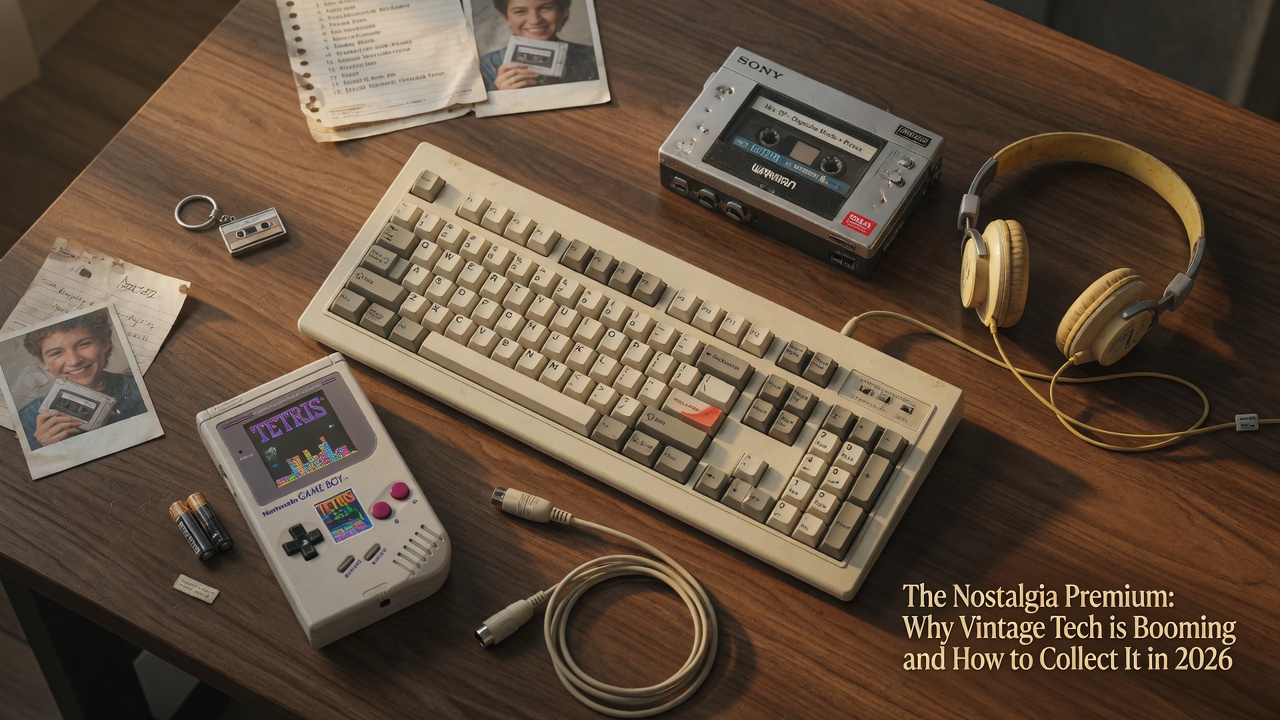
The Nostalgia Premium: Why Vintage Tech is Booming and How to Collect It in 2026
There was a time when “vintage electronics” was a polite euphemism for “obsolete e-waste.” Old cassette players, bulky CRT monitors, and first-generation handheld game consoles were routinely discarded in favor of sleeker, faster, and more connected alternatives.
Today, that narrative has completely reversed.
As we navigate 2026, vintage technology is no longer viewed as outdated junk; it is celebrated as tangible history, functional art, and a highly lucrative asset class. The global vintage and retro goods market was valued at approximately $75 billion in 2024 and is projected to double to $150 billion by 2032, growing at a steady compound annual growth rate (CAGR) of 10% [[3]]. Within this broader trend, the retro gaming console market alone hit $3.8 billion in 2025 and is on pace to reach $4.18 billion in 2026 [[16]].
But this boom is not just about financial speculation. It is deeply rooted in human psychology. In an era defined by intangible cloud storage, subscription fatigue, and algorithmic feeds, consumers are craving the tactile, predictable, and deeply personal nature of analog and early-digital technology. Here is the data-backed reality of the nostalgic tech market in 2026, and how you can navigate it whether you are a casual enthusiast or a serious collector.
The Psychology of Nostalgia: Why We Crave Old Tech
To understand the financial value of a 1980s boombox or a 1990s Game Boy, you must first understand the emotional driver behind the purchase: nostalgia. In psychological terms, nostalgia is not merely a longing for the past; it is a complex, predominantly positive emotion that serves a vital regulatory function.
Research in the psychology of nostalgia demonstrates that reflecting on cherished past experiences acts as a powerful buffer against anxiety, loneliness, and existential threat [[19]]. It provides a profound sense of self-continuity, reminding us of who we were and anchoring us in a rapidly changing world [[20]].
Modern technology, for all its convenience, is often a source of stress. Smartphones demand our constant attention, software updates break familiar workflows, and digital files can vanish with a corrupted hard drive. Vintage technology offers the exact opposite: it is finite, physical, and operates within clear, understandable mechanical boundaries. Turning a physical key, hearing the tactile click of a mechanical keyboard, or inserting a cartridge into a console provides a sensory feedback loop that a glass touchscreen simply cannot replicate. We are not just buying old gadgets; we are buying a sense of control and comfort.
The Financial Reality: Nostalgia as an Alternative Asset Class
While the emotional appeal is strong, the financial data surrounding vintage tech is what has captured the attention of serious investors. Over the last five years, limited-edition and well-preserved retro technology has seen a compound annual growth rate (CAGR) of 18%, significantly outperforming many traditional collectibles like stamps or coins [[4]].
The market has matured from a niche hobbyist exchange into a structured, high-stakes auction environment. For example, a sealed copy of a classic Nintendo game sold for $300,000 at Heritage Auctions in mid-2025, while an original Apple-1 prototype circuit board fetched an astonishing $2.75 million at RR Auction in January 2026 [[6]].
These are not isolated anomalies driven by internet hype. They reflect a collector market that now treats documented provenance, original packaging, and third-party professional grading as the primary drivers of price valuation [[6]]. Just as the art world relies on authentication, the vintage tech market now relies on specialized grading services to verify that a device is original, unmodified, and in stated condition.
What Collectors Are Actually Paying For in 2026
If you are looking to dip your toes into nostalgic tech, it is crucial to understand that not all old electronics hold value. A scratched, non-functional mass-market DVD player from 2005 has no collector value. The premium is reserved for specific categories:
- Iconic First-Generation Products: The original iPod Classic, the first Sony Walkman (TPS-L2), or the original Macintosh. These represent paradigm shifts in consumer behavior.
- Sealed or “New Old Stock” (NOS) Items: Video games, software, or gadgets that have never been opened command exponential premiums because they represent a pristine, time-capsule state of manufacturing.
- High-End Audio and Mechanical Gear: Vintage receivers, turntables, and mechanical keyboards from the 1970s and 1980s are highly sought after not just for nostalgia, but because many audiophiles and enthusiasts argue they were built with superior, more durable components than modern equivalents.
- Developer Prototypes and Engineering Samples: Items that were never meant for public release, offering a rare glimpse into the iterative design process of legendary tech companies.
How to Start a Nostalgic Tech Collection (Without Getting Scammed)
The surge in popularity has inevitably attracted bad actors. The market is flooded with refurbished items sold as “original,” counterfeit cartridges, and devices with replaced, non-original parts. If you are building a collection in 2026, you must adopt a rigorous, analytical approach.
1. Prioritize Provenance and Documentation
A vintage device with its original box, manuals, and receipt is worth significantly more than a loose unit. More importantly, this documentation serves as proof of authenticity. When purchasing high-value items, always ask for the complete history of the device. Where was it stored? Has it been opened or repaired? A seller who cannot provide a clear, consistent history is a major red flag.
2. Understand the “Frankenstein” Risk
In the retro gaming and vintage computing communities, a “Frankenstein” device is one that has been cobbled together from parts of multiple broken units. While it may function perfectly, collectors heavily discount these items. Learn to identify the specific hallmarks of originality for your niche. For example, knowing the exact font and color of the text on a 1980s circuit board, or recognizing the specific screws used by a manufacturer, can save you from buying a heavily modified device.
3. Leverage Professional Grading for High-Value Purchases
If you are spending more than a few hundred dollars on a collectible gadget or game, insist on third-party grading. Services like WATA or VGA for video games, or specialized electronics authenticators, seal the item in a tamper-evident case and assign it a numerical grade based on condition. This not only guarantees authenticity but also ensures the item will be liquid and easy to resell in the future.
4. Join the Community
The best knowledge in the vintage tech space is not found in generic price guides; it is held by passionate communities. Join dedicated subreddits, Discord servers, and specialized forums for the specific niche you are interested in (e.g., vintage Apple computers, retro handhelds, or classic hi-fi audio). These communities are invaluable for spotting fakes, finding fair market prices, and connecting with reputable sellers.
The Future of Nostalgic Reviews
As we look toward the end of the decade, the definition of “vintage” is inevitably creeping forward. The smartphones, early smartwatches, and first-generation wireless earbuds of the 2010s are already beginning to be viewed through a nostalgic lens by Gen Z consumers. The cycle of technological obsolescence followed by nostalgic revival is a permanent feature of consumer culture.
However, the core appeal will remain the same. In a world that is increasingly virtual, ephemeral, and automated, the enduring value of vintage technology lies in its physical reality. It is a reminder of a time when we owned our tools, when we could open them up and understand how they worked, and when the simple act of pressing “play” required a deliberate, satisfying mechanical action.
Sources & References
- [3] Future Data Stats. (2024/2026). Vintage and Retro Goods Market Size & Industry Growth: Valued at USD 75 Billion in 2024, projected to reach USD 150 Billion by 2032 at a 10% CAGR. Retrieved from futuredatastats.com
- [4] Heritage Auctions / Taobao Shopping Guide. (2025/2026). Why Vintage Gadgets Are Valuable Investments: Limited edition retro tech has seen a CAGR of 18% in the last five years, outperforming many traditional collectibles. Retrieved from world.taobao.com
- [6] Morning Overview. (2026). 6 vintage electronics collectors are paying real money for: A sealed copy of The Legend of Zelda sold for $300,000 in 2025, and an Apple-1 prototype board fetched $2.75 million in January 2026, driven by documented provenance and grading. Retrieved from morningoverview.com
- [16] Quantum Run Consulting. (2025/2026). Retro Gaming Console Sales Statistics 2026: The global market hit $3.8 billion in 2025 and is on pace to reach $4.18 billion in 2026. Retrieved from quantumrun.com
- [19] Taylor & Francis Online. (2025). Nostalgia and self-humanity: The psychology of nostalgia delineates the emotion’s nature and functions, acting as a buffer against anxiety and providing self-continuity. Retrieved from tandfonline.com
- [20] Archbridge Institute. (2025). Historical Nostalgia in Modern America: Explores how the psychology of nostalgia shapes consumer trends and provides comfort in a rapidly changing world. Retrieved from archbridgeinstitute.org
The Bottom Line
Nostalgic tech reviews and collecting in 2026 are about much more than hoarding old plastic and silicon. It is a celebration of design history, a psychological refuge from digital fatigue, and a surprisingly robust alternative investment strategy. Whether you are hunting for a childhood Game Boy or a pristine first-generation iPod, approach the market with research, demand authenticity, and remember that the true value of these devices lies in the tangible memories they hold.